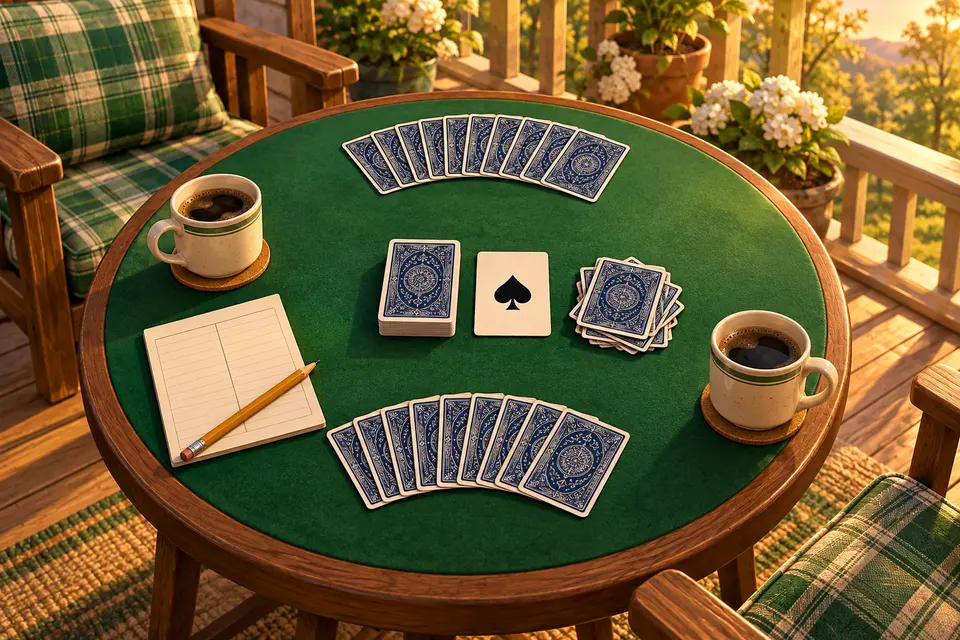
Spades is a partnership game at heart: four players, two teams, partners sitting across from each other. But sometimes there are only two of you — a couple at the kitchen table, or two friends waiting for the others to arrive. The good news is that Spades works with two players. You only need to change how the hands are made.
This guide explains the usual two-player version, how bidding and scoring carry over, and how the game feels different when there’s no partner across the table.
What changes with two players
In four-player Spades the whole deck is dealt out, 13 cards each. With two players that would mean 26 cards each — and since you’d know every card your opponent held, there would be nothing left to guess. Instead, two-player Spades has no deal. The players build their hands by drawing from the deck, keeping some cards and throwing others away, until each holds 13. Then the hand is bid and played much like the normal game.
| Four-player Spades | Two-player Spades | |
|---|---|---|
| Teams | Two partnerships | Every player for themselves |
| Getting your cards | All 52 cards dealt, 13 each | Draw and discard until you hold 13 |
| Cards in play | All 52 | 26 (the other 26 are discarded) |
| Bidding | Your bid plus your partner’s is the contract | Your bid is your whole contract |
| Nil | Your partner can protect you | Nobody to cover you |
| Tricks per hand | 13 | 13 |
Building your hands: the draw
Shuffle a standard 52-card deck and put it face down between the two players. Then take turns, one player at a time, following these steps:
- Look at the top card of the deck without showing it.
- Keep it or not. If you want it, put it in your hand. Then look at the next card and discard it face down on a discard pile.
- If you don’t want the first card, discard it face down instead, and take the next card into your hand. You must keep that second card, whatever it is.
Either way, each turn puts one card in your hand and one on the discard pile. After 13 turns each, the deck is gone, both players hold 13 cards, and 26 cards sit face down in the discard pile, out of play for the rest of the hand. Nobody may look through the discards.
That’s the method described on Pagat, the well-known card game rules site, and it’s the version we’d suggest starting with. You’ll also meet a few small variations:
- Draw two, keep one. Each turn you take the top two cards, keep one and discard the other. It’s a little gentler, since you always see both cards before you choose.
- No peeking at the second card. If you keep the first card, the next one goes straight to the discard pile unseen. It adds a little luck, and a little more mystery about which cards are out of play.
- Face-up discards. Some families discard face up, so both players can see which cards are out of play. It turns the draw into more of a memory game.
Agree on which one you’re using before you start. The rest of this guide uses the standard method above.
Who goes first
Decide who draws first; a simple way is to let the player who didn’t shuffle start the draw, then alternate the shuffle from hand to hand. The same player bids first and leads first, just as the player on the dealer’s left does in the four-player game.
Bidding
Once both hands are built, each player bids how many of the 13 tricks they expect to win, from 1 to 13, or Nil if you play it. There’s one round of bidding and no going back.
Without a partner, your bid is your entire contract. In the four-player game a cautious bid can be rescued by your partner’s extra trick; with two players, every trick you count on has to come from your own hand.
Counting tricks in a built hand
The basics are the same as always:
- High spades are the surest tricks. The Ace of spades always wins one.
- Long spades win tricks late in the hand, once your opponent runs out.
- Side-suit Aces are good for a trick each, Kings less so.
- Voids let you trump the first time that suit is led.
The big difference is that half the deck isn’t in play. A King becomes the top card of its suit if the Ace was discarded, but unless you threw that Ace away yourself, you can’t know whether it was. That uncertainty is part of the fun, so bid a little more cautiously than you would with a partner.
Playing the hand
Play follows the normal Spades rules:
- The first bidder leads to the first trick. After that, whoever wins a trick leads the next one.
- Follow suit if you can. If you can’t, play any card, including a spade.
- The highest spade wins the trick; if no spade was played, the highest card of the suit led wins.
- Spades can’t be led until a spade has been played on another suit (“spades are broken”), unless you have nothing but spades.
All 13 cards in each hand are played, so there are still 13 tricks.
Scoring
Score each player exactly as you would score a team in the four-player game:
| Result | Points |
|---|---|
| Make your bid | 10 for every trick bid |
| Each extra trick (a bag) | +1 |
| Miss your bid (you are set) | −10 for every trick bid |
| Nil made / failed | +100 / −100 |
| Every 10 bags | −100 |
The first player to 500 points wins. For a shorter evening, play to 250 or 300. If you’d like the full details, including Blind Nil and the house rules people argue about, our Spades rules guide covers them with examples.
A worked example
You bid 4 and your opponent bids 6. You take 5 tricks and they take the other 8. You made your bid with one trick to spare, so you score 40 + 1 = 41. They made theirs with two to spare: 60 + 2 = 62.
Now swap the results: you take 8 tricks and they take 5. You score 40 + 4 bags = 44. They bid 6 but took only 5, so they are set and lose 60.
How strategy changes for two
During the draw
The draw is where a two-player hand takes shape.
- Keep spades, especially high ones. They’re trumps, and in a head-to-head game a long spade suit is the best protection you can have.
- Build a void on purpose. If you’ve kept no diamonds after a few turns, you can keep throwing them away and trump diamond leads later.
- Be picky early, practical late. Turning down a card means taking the next one blind, so a decent card in hand beats a gamble on a mystery card — especially in the last few turns.
- Remember what you threw away. You’ve seen 26 cards: your hand and your own discards. The other 26 are split evenly between your opponent’s hand and their discards. Since they kept the best cards they were offered, assume the high spades you never saw are in their hand.
During the play
- Every trick is head to head. With no partner to help, leading a King while the Ace is still unseen is a straight guess about your opponent’s hand.
- Lead your long side suit. Make your opponent follow until they run out, then make them spend a spade to win.
- Count spades as they fall. With only 26 cards in play, you won’t know exactly how many spades are out — but you know how many you’ve seen, and that’s often enough.
Nil without a partner
Nil works the same way if you play it: take no tricks for 100 points, take any for −100. With two players there’s no partner to win the tricks you’re stuck with, so a Nil needs a genuinely low hand with short spades. If that sounds too risky, simply agree to play without Nil.
Three players: Cutthroat Spades
Have three at the table? That’s Cutthroat Spades: deal 17 cards each, set the last card aside, and everyone bids and scores alone. The Spades rules explain the details.
Play the four-player game online
Two-player Spades is a fine way to keep your skills sharp, but the partnership game is where Spades really shines. On BieGames, Spades is the classic four-player partnership game: you play with June, a computer partner, against Rose and Hank. There’s nothing to download, you can choose Easy, Normal or Hard computer players, and the Hint button suggests a bid or a card while you learn.
If Spades has you hooked on trick-taking games, our comparison of Spades vs Hearts explains how its closest cousin plays. And for more games built for two from the start, see our list of the best 2-player card games.
Play Spades free
Every game on BieGames runs right in your browser — no download, no sign-up, friendly computer players.