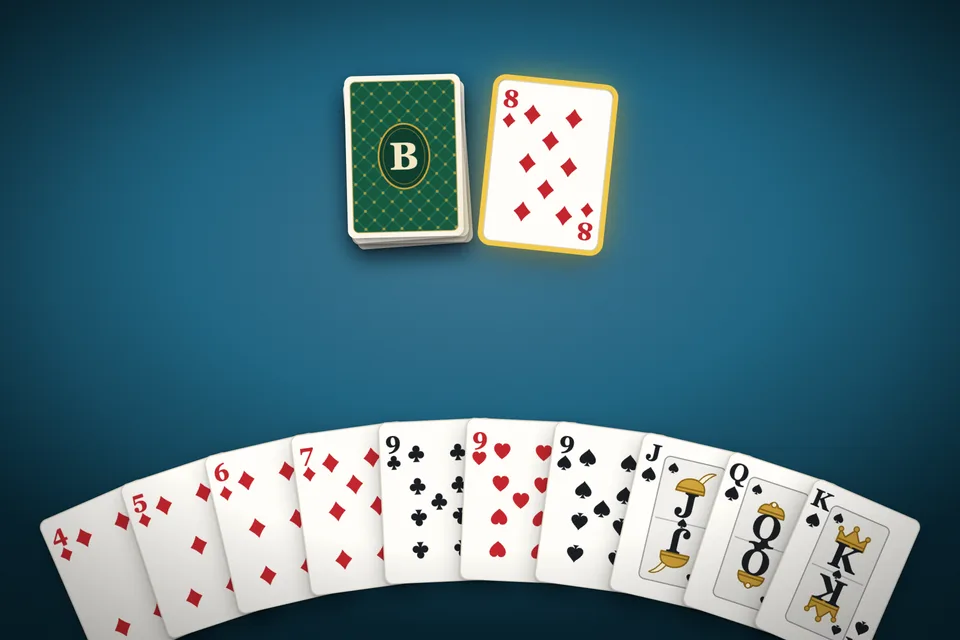
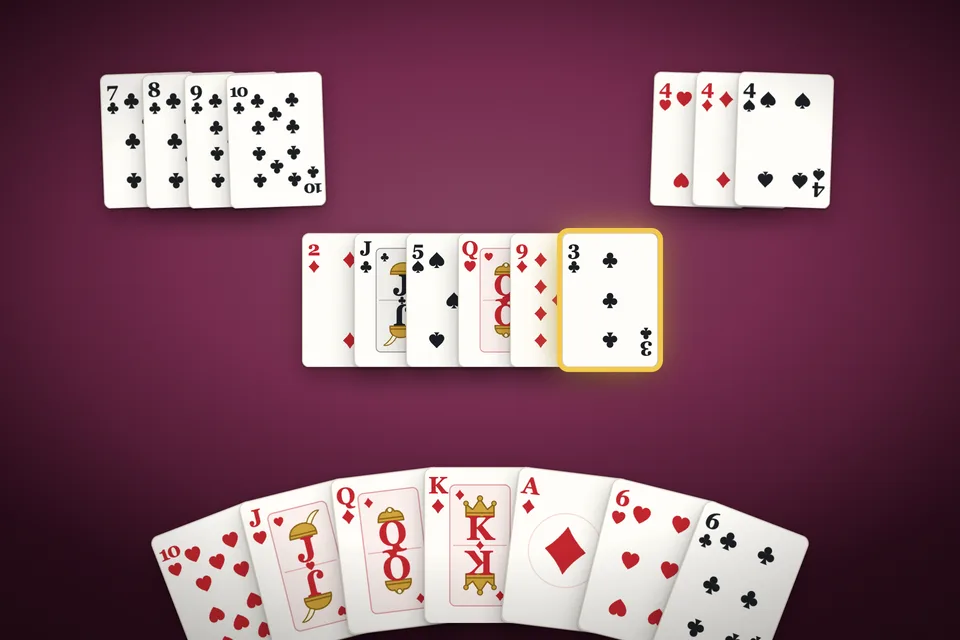
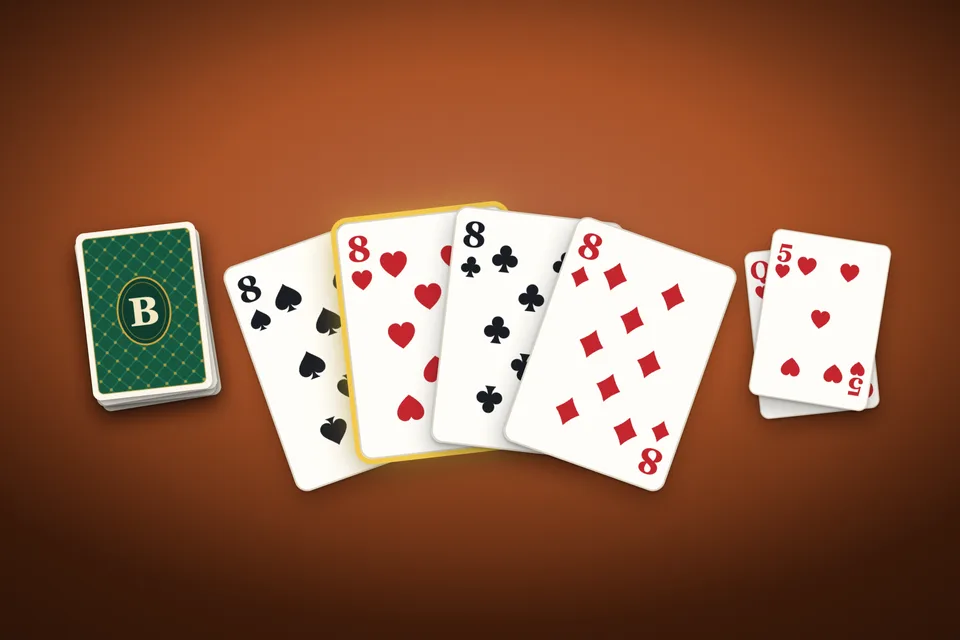
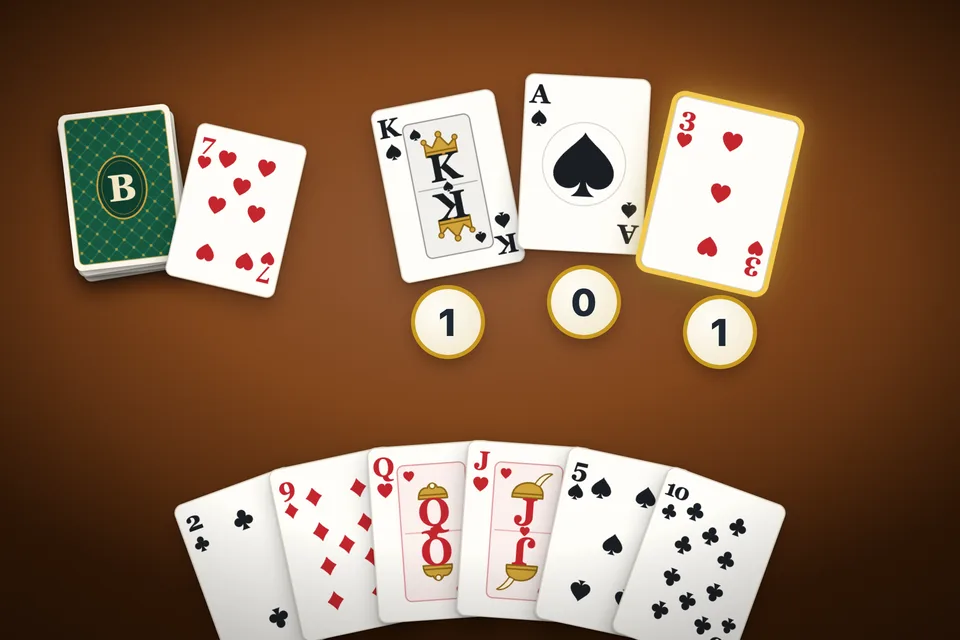
Play the Hand and Foot card game online for free — with a computer partner against two friendly opponents, or one-on-one. Play out your hand, pick up your foot, build seven-card books and go out first.
How to play Hand and Foot
Hand and Foot is a member of the Canasta family, and a favorite at many family card tables in North America. Like Canasta, you meld cards of the same rank, twos and jokers are wild, and the big points come from books — melds of seven cards. The twist is in the name: every player gets two packets of cards. You play your hand first, and only when it's used up do you pick up your foot and play on. You'll also see it called Hand and Foot Canasta.
Cards and the deal
Hand and Foot uses one more standard deck than there are players, jokers included: three decks for two players and five decks for four. Each player is dealt two packets of 11 cards. The hand is picked up; the foot stays face down until later. The rest of the cards form the stock, and one card is turned up to start the discard pile. In the four-player game, partners sit across from each other and share their melds.
Your turn
- Draw. Take the top two cards of the stock — or pick up the discard pile (see below).
- Meld as many cards as you like, or none.
- Discard one card to end your turn.
Melds and books
A meld is three to seven cards of the same rank, such as three Kings. There are no runs in Hand and Foot. You can meld 4s through Kings and Aces. Twos and jokers are wild and can stand in for any rank, but the natural cards in a meld must always outnumber the wild ones: two Kings and a joker is fine, one King and two wild cards is not. Your side keeps one unfinished meld of each rank, and any card of that rank you play goes onto it.
When a meld reaches seven cards it becomes a book and is closed. A book with no wild cards is a clean (or natural) book, worth 500. A book with any wild cards is a dirty book, worth 300. After a book is closed, you can start a new meld of the same rank.
The opening meld
Each round, your side's first melds must add up to a minimum, counting only the card values: 50 in round one, 90 in round two, 120 in round three and 150 in round four. You can lay down several melds in the same turn to reach it. Once your side is open, there's no minimum for the rest of the round — for you or your partner.
Picking up the discard pile
Instead of drawing from the stock, you may take the top seven cards of the discard pile (or all of it, if it's smaller) when you hold a natural pair that matches the top card. The top card and your pair go down at once as a meld, and the other cards join your hand. You can't pick up the pile when a black 3 or a wild card is on top. If your side hasn't opened yet, the top card and cards from your hand must reach the minimum — the other cards you pick up don't count toward it.
Red threes and black threes
A red 3 goes straight onto the table as soon as you get it, and you draw a replacement. Each one is worth 100 to your side. Black 3s can't be melded at all. You get rid of them by discarding, and a black 3 on top of the pile stops the next player from picking it up.
Picking up your foot
When you have played every card in your hand, you pick up your foot. If you melded your last card, you pick it up right away and keep playing. If your last card was a discard, you pick it up and play it on your next turn.
Going out
You can go out once you're playing from your foot and your side has made at least two clean books and two dirty books. In the partnership game, your partner must have picked up their foot too, and you ask "May I go out?" before you do. Then you meld all your cards, or meld all but one and discard it. Going out ends the round and earns 100. If you can't go out yet, you must keep at least two cards after melding — one to discard and one to hold.
A round also ends when the stock runs out and the next player can't use the discard pile, or when a red 3 has no card left in the stock to replace it. A full game is four rounds, and the side with the higher total wins.
Playing on BieGames
Tap the stock to draw, or tap the discard pile to pick it up. Select cards in your hand and press Meld, or tap one of your glowing melds to add to it. Select one card and press Discard to end your turn. You can drag cards too: onto a meld, onto the discard pile, or into your meld row to start a new one. On a keyboard, Tab and the arrow keys move between cards, Enter selects, and D draws, P picks up the pile, M melds and H asks for a hint. Undo takes back your melds until you discard — but never a draw, a pickup or your foot, because you've already seen those cards.
Hand and Foot scoring
Hand and Foot scores are big numbers, mostly because of the books. At the end of each round, each side adds up four things and subtracts one:
| Item | Points |
|---|---|
| Clean book (seven cards, no wilds) | 500 |
| Dirty book (seven cards with wilds) | 300 |
| Each red 3 on the table | 100 |
| Going out | 100 |
| Every card melded | Its card value |
| Every card left in your hand or foot | Minus its card value (a red 3 left in a foot is minus 100) |
Card values
| Card | Value |
|---|---|
| Joker | 50 |
| 2 (wild) and Ace | 20 |
| 8 through King | 10 |
| 4 through 7 | 5 |
| Black 3 | 5 |
A scoring example
Say your side finishes a round with two clean books and two dirty books, one red 3 and a few open melds, and you go out. The books bring 2 × 500 + 2 × 300 = 1,600. The red 3 adds 100, going out adds 100, and the cards in all your melds add up to 410. Your partner is still holding 35 points of cards, which come off. Your side scores 1,600 + 100 + 100 + 410 − 35 = 2,175 for the round. The other side scores its own books and melds the same way, minus everything left in both of their hands and feet — which can be a lot when the round ends early.
BieGames keeps the score for you and shows the full breakdown after each round.
Hand and Foot strategy tips
- Get into your foot. Cards still in your foot when the round ends count against you, and you can't go out without it. Playing out your hand quickly is usually worth more than holding cards back.
- Keep pairs. A natural pair is your ticket to the discard pile. Seven cards and a free meld can turn a round around.
- Guard your clean books. Clean books are worth 200 more than dirty ones, and you need two of each to go out. Don't sprinkle wild cards over a meld that's on its way to being clean.
- Use wild cards to finish books. A wild card is at its best closing a dirty book, or getting your last few cards down so you can pick up your foot.
- Throw black 3s early. They can't be melded, they count against you, and each one blocks the pile for the next player.
- Don't feed the next player. Before you discard, think about whether that card could match a pair they're holding — especially a rank they just picked up.
- Watch the other side. Once they have their books and are down to a few cards in their feet, the round could end any moment. Get your points onto the table.
- Talk to your partner with your melds. Your melds are shared, so every card you add helps your partner finish a book too.
Our rules and common house variations
Almost every family plays Hand and Foot a little differently. BieGames follows the widely played North American rules described on this page: 11-card hands and feet, one more deck than players, a pickup of seven cards with a natural pair, natural cards outnumbering wilds, and two clean plus two dirty books to go out. Some tables change things like these:
- Packet size. Some deal 13 cards to each hand and foot, or 11 to the hand and 13 to the foot.
- Wild books. Some count a book made only of wild cards as a big bonus, and require one to go out.
- The pile. Some take the whole discard pile instead of seven cards, or allow a pickup with two wild cards when a wild is on top.
- Wild limits. Some allow only one wild card in a meld of three to five cards and two in a meld of six or seven.
- Books to go out. Requirements range from one clean and one dirty book to several of each.
- Red 3 penalties. Some charge more than 100 for red 3s left in a hand or foot.
Choose two-player or partnership play, and a full four-round game or a quick one-round game, in Settings. You can also pick how strong your opponents and partner play: Easy melds whatever it can and isn't careful with discards, Normal plays a solid game, and Hard remembers what's been thrown, guards its clean books and keeps pairs for the pile. The Daily button deals the same game to everyone each day.
Want every detail, with examples and the common house rules? Read our complete Hand and Foot rules guide.
Hand and Foot FAQ
How many cards do you deal in Hand and Foot?
Each player gets two packets of 11 cards: a hand, which you pick up and play first, and a foot, which stays face down until your hand is used up. Some families deal 13 cards instead.
How many decks do you need for Hand and Foot?
Use one more standard deck than there are players, with the jokers left in: three decks for two players and five decks for four. Shuffle them all together.
What are the meld requirements for each round?
Your side’s first melds each round must add up to at least 50 points in round one, 90 in round two, 120 in round three and 150 in round four. Only card values count — not books or red 3s.
When can you pick up the discard pile in Hand and Foot?
When you hold two natural cards that match the top card, and the top card isn’t a black 3 or a wild card. You take the top seven cards, and the top card and your pair go straight down as a meld.
What is the difference between a clean book and a dirty book?
Both are seven-card melds of one rank. A clean book has no wild cards and scores 500. A dirty book includes one or more twos or jokers and scores 300.
How many books do you need to go out?
In our rules, your side needs two clean books and two dirty books, you must be playing from your foot, and in the partnership game your partner must have picked up their foot. House rules vary from one book of each to several.
What do red 3s and black 3s do in Hand and Foot?
A red 3 goes face up on the table as soon as you get it, scores 100, and you draw a card to replace it. A black 3 can’t be melded; discard it to block the next player from picking up the pile. A black 3 left in your hand costs 5.
Can you play Hand and Foot with two players?
Yes. With two players you each play your own hand and foot using three decks, and you need the books yourself. Choose You vs. one under Players in Settings.
Is Hand and Foot the same as Canasta?
It’s a close relative. Both are played with several decks, wild twos and jokers, red and black 3s and seven-card books. Hand and Foot adds the second packet of cards — the foot — and uses rising meld requirements over four rounds.
How long does a game of Hand and Foot take?
A full game is four rounds. On BieGames a round usually takes 5 to 10 minutes, and you can choose a quick one-round game in Settings. Your game is saved if you leave and come back.