Play Spider Solitaire online free in your browser. Pick 1, 2 or 4 suits, drag cards or just tap them, and use unlimited undo and smart hints — there is a new daily deal every day, and nothing to download.
How to play Spider Solitaire
This page gets you started. For the complete rules, with a worked opening, scoring examples and the rule questions people argue about, read our complete Spider Solitaire rules guide.
Spider Solitaire is a one-player card game played with two decks' worth of cards — 104 in all. The goal is to clear the table by building eight complete runs, each going from King down to Ace in a single suit. Every time you finish one, it leaves the table on its own. Clear all eight and you win.
The layout
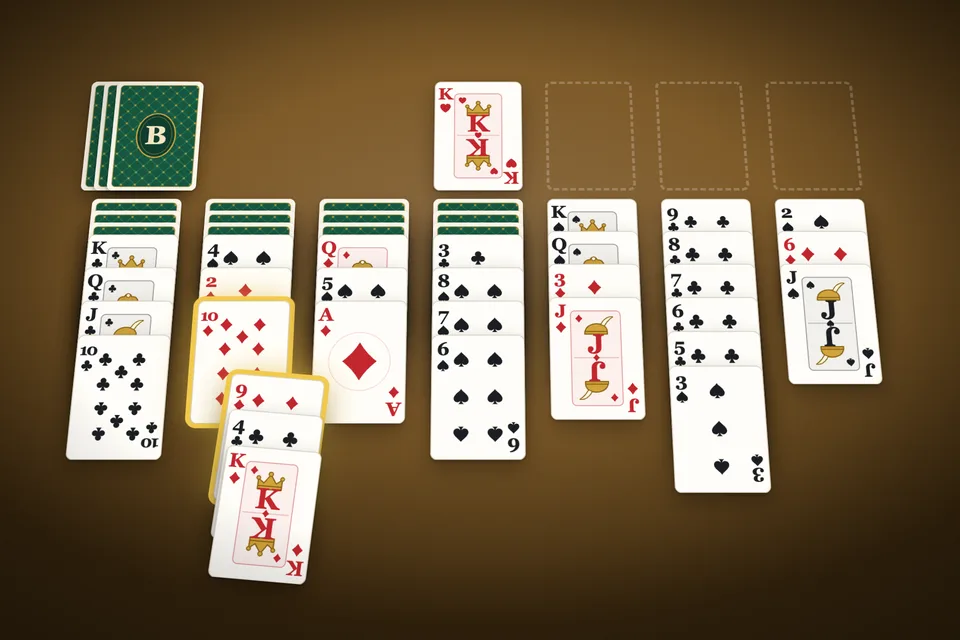
- The tableau is the row of ten columns that fills the table. The first four columns get six cards each and the other six get five, for 54 cards in all. Only the bottom card of each column starts face up.
- The stock is the face-down pile in the top-left corner. It holds the other 50 cards, which come out ten at a time in five deals.
- The foundations are the eight spaces along the top. You never build on them yourself — a finished King-to-Ace run moves there automatically.
Moving cards
- Build down, in any suit. You can put a card on any face-up card one rank higher, whatever its suit: a 6 on any 7, a Jack on any Queen. Aces are low, so nothing goes on an Ace, and a King can only move to an empty column.
- Move runs that share a suit. A group of cards can move together only if it runs down in order and in one suit, like 9♠ 8♠ 7♠. A mixed run such as 9♠ 8♥ 7♠ has to be taken apart one card at a time. That one rule is what makes Spider such a satisfying puzzle.
- Turn over hidden cards. When you move the last face-up card off a column, the face-down card beneath it flips over automatically.
- Use empty columns. Any card, or any same-suit run, can move into an empty column. Empty columns are the most valuable space in the game, so use them wisely.
- Finish runs. As soon as a column ends with a full King-to-Ace run in one suit, those 13 cards fly off to the foundations and you score 100 points.
Dealing from the stock
When you run out of useful moves, tap the stock. It deals one face-up card onto the bottom of every column — ten cards at once. There are five deals in a game. As in classic Windows Spider, you can't deal while a column is empty, so fill every empty column first. (The one exception: if fewer than ten cards are left on the table, there aren't enough to go around, and you can deal anyway.)
Winning
You win when all eight runs are finished and the table is clear. Not every deal can be won, especially with four suits, but careful play and a little patience will take you a long way.
Playing on BieGames
Drag a card, or a same-suit run, and drop it where you want it. Or simply tap a card and it jumps to the best spot it can go: onto a card of the same suit first, then onto any suit, then into an empty column. Prefer to pick the spot yourself? Switch Tapping a card to Selects it in Settings, then tap the glowing destination. Tap the stock, or press the Deal button, to deal ten more cards.
On a keyboard, press 1–9 and 0 to pick up the movable run in a column and then a second number to drop it, D to deal, H for a hint, Esc to let go, and Ctrl+Z (⌘Z on a Mac) to undo. Tab, the arrow keys, Enter and Space work too. Your game is saved as you play, so you can close the page and pick it up later.
1 suit vs. 2 suits vs. 4 suits
Spider comes in three levels, and you choose one in Settings. Every level uses 104 cards in ten columns — what changes is how many different suits are mixed together.
1 suit (easy)
All 104 cards are Spades: eight full sets from Ace to King. Since every card matches every other, any run you build is a same-suit run that can move as one. One-suit Spider is relaxed and forgiving, and most deals can be won. It is the perfect way to learn the game, and a lovely way to unwind.
2 suits (medium)
The cards are four sets of Spades and four sets of Hearts. Now a red 8 on a black 9 is a legal move, but the two cards can't travel together, so you have to think about where you build. Two-suit Spider is a real challenge without being punishing, and many players find it the most fun. To jump straight in at this level, play 2 Suit Spider Solitaire.
4 suits (hard)
This is two ordinary decks: two sets of every suit. Mixed runs pile up quickly, and sorting them out takes careful planning, clever use of empty columns and a fair bit of luck. Four-suit Spider is one of the toughest solitaire games around — winning even a few is something to be proud of. Ready for it? Play 4 Suit Spider Solitaire.
The daily deal
Every day there is one daily deal, shuffled the same way for everyone. You play it at whichever number of suits you have chosen. Win it to build your daily streak, then come back tomorrow for a new one.
Spider Solitaire scoring
BieGames uses the classic Windows scoring for Spider Solitaire:
| Event | Points |
|---|---|
| Starting score | 500 |
| Each move (including a deal from the stock) | −1 |
| Each undo | −1 |
| Each finished King-to-Ace run | +100 |
Because every move costs a point, the score rewards efficient play. A won game always earns the 800 points for its eight runs, so your final score is 1,300 minus the number of moves you made. Win in fewer than 300 moves and you will break 1,000. Your best score, fastest time and fewest moves are kept separately for 1, 2 and 4 suits.
Spider Solitaire strategy tips
- Turn over face-down cards. Hidden cards are what stop you. When you have a choice, make the move that flips a card — and the columns with the fewest hidden cards are often the quickest to clear completely.
- Build in suit whenever you can. If a 7♥ could go on the 8♥ or the 8♠, choose the 8♥. Same-suit runs can move together later; mixed runs lock cards in place.
- Empty a column early. An empty column is the most powerful tool in Spider. It lets you park a card, untangle a mixed run or swap two runs around. Aim to clear one in the first few minutes.
- Don't fill empty columns lightly. Moving a lone card into an empty column wastes it. Use the space to reach a hidden card or to rebuild a run in suit, and keep it free if you can.
- Move Kings into empty columns with care. A King can only ever move to an empty column, so placing one there is permanent. Put a King there when it frees up hidden cards or starts a long same-suit run.
- Play every useful move before you deal. A deal drops a new card on every column and can bury the runs you have been building. Look over the whole table first — the card you need may already be showing.
- Get ready for each deal. Before you tap the stock, tidy up: finish any runs you can and put cards where a new card landing on top will hurt the least.
- Swap mixed runs back into suit. If a 5♠ sits on a 6♥ and there's a 6♠ free elsewhere, move it over. Little fixes like that turn messy columns into runs you can move.
- Lean on Undo and Hint. Undo is unlimited, so explore a line of play and step back if it goes nowhere. Hint looks a few moves ahead without peeking at hidden cards; press it again for the next idea.
A short history of Spider Solitaire
Spider belongs to the family of patience games — the British name for solitaire — that became a favorite pastime across Europe and North America in the 1800s. It is a two-deck game, and it has appeared in card game books since at least the early twentieth century. Its name is usually explained by its eight foundations: a spider has eight legs, and you have eight runs to finish.
The game reached millions of new players when Microsoft added Spider Solitaire to Windows. It first appeared in the Microsoft Plus! 98 add-on pack and then came free with Windows Me and Windows XP. That version introduced the one-, two- and four-suit levels that most players know today, along with the simple scoring of 500 points to start, one point off for every move and 100 points for every finished run. Since then, Spider has become one of the most played solitaire games in the world.
If you enjoy Spider, you may also like FreeCell, which shows every card from the start, or classic Klondike Solitaire. Our guide to card games to play alone compares them side by side.
Want every detail, with examples and the common house rules? Read our complete Spider Solitaire rules guide.
Spider Solitaire FAQ
Is Spider Solitaire free to play?
Yes. BieGames Spider Solitaire is completely free, with no download and no sign-up. It works in any modern browser on phones, tablets and computers, and your game is saved automatically so you can come back to it later.
What is the difference between 1, 2 and 4 suit Spider Solitaire?
All three use 104 cards. One suit uses only Spades, so every run you build can move together — it is the easiest. Two suits mixes Spades and Hearts, and four suits uses two ordinary decks, which makes building same-suit runs much harder. Choose the level in Settings, or open 2-suit or 4-suit Spider directly.
Why can’t I move a group of cards?
In Spider, a group of cards can only move together if it runs down in order and in one suit, such as 9♥ 8♥ 7♥. If the suits are mixed, you have to move the cards one at a time — or rebuild them in suit first.
Why can’t I deal from the stock?
You can’t deal while any column is empty. Move a card or run into every empty column first, then deal. The only exception is when fewer than ten cards are left on the table, so the columns can’t all be filled.
How many times can you deal in Spider Solitaire?
Five. The stock holds 50 cards, and each deal puts one card on each of the ten columns. You can’t deal while a column is empty, unless fewer than ten cards are left on the table.
Can you put any card in an empty column in Spider Solitaire?
Yes. Unlike Klondike, where only a King can fill an empty column, Spider lets any card — or any run in one suit — move into an empty column. That is why an empty column is so valuable.
Can every game of Spider Solitaire be won?
No. Some deals can’t be won no matter how you play, and four-suit games are especially tough. Most one-suit games can be won with patience, and unlimited undo means you can always try another way.
How is Spider Solitaire scored?
You start with 500 points. Every move, deal and undo costs one point, and every finished King-to-Ace run earns 100. A won game scores 1,300 minus the number of moves you made.
Is there an undo button and hints?
Yes. Undo is unlimited — use the Undo button or Ctrl+Z (⌘Z on a Mac). The Hint button suggests the best move it can find without peeking at face-down cards; press it again to see another idea.
What is the daily deal?
Each day everyone gets the same shuffle, played at the number of suits you have chosen. Win it to build a daily streak, and come back tomorrow for a new one.