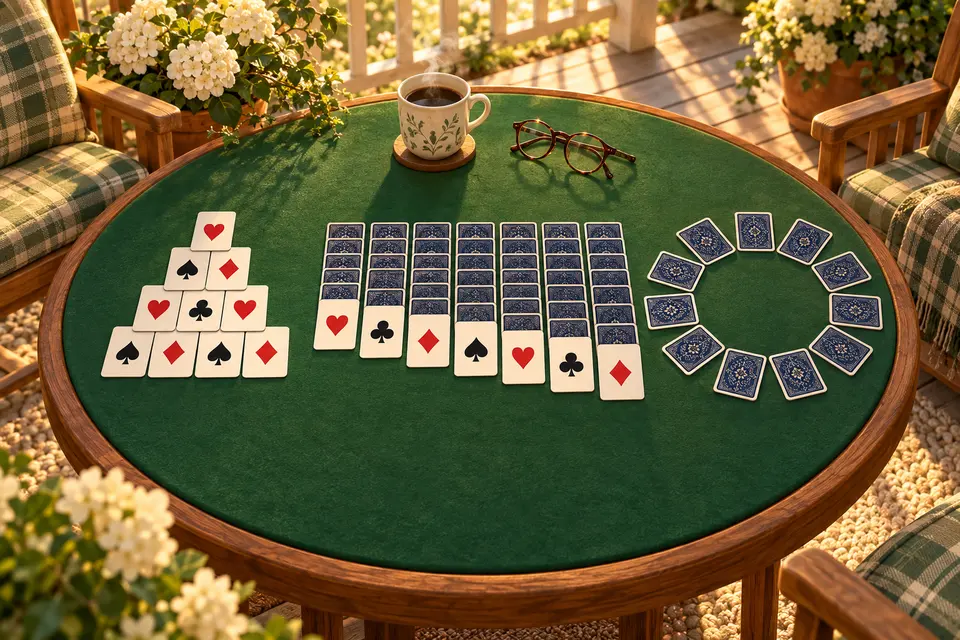
You don’t need a partner, a fourth for bridge or even a table full of family to enjoy a good card game. Some of the best games ever invented are played alone — and with a single deck (or a browser tab), you can play them anywhere.
The British call these games patience, which is a good description. They reward a calm, careful mind more than quick reflexes. Here are the solo card games worth knowing, what makes each one different, and how to pick the right one for your mood.
The quick comparison
| Game | Difficulty | Luck or skill | Typical game | Best for |
|---|---|---|---|---|
| Klondike Solitaire | Easy to learn, tricky to master | A mix of both | 5–10 minutes | Everyday relaxing play |
| FreeCell | Medium | Almost all skill | 5–15 minutes | Puzzle lovers |
| Spider Solitaire | Easy to hard (1, 2 or 4 suits) | More skill than luck | 10–20 minutes | Long, absorbing sessions |
| Pyramid Solitaire | Easy | Mostly luck | 3–5 minutes | Quick breaks and simple math |
| Golf | Easy | Mostly luck | 3–5 minutes | Short, fast rounds |
| Clock | Very easy | Pure luck | 5 minutes | Winding down |
Klondike: the classic
When most Americans say “Solitaire,” they mean Klondike — the game with seven columns, a stock pile and four foundations that came free on every Windows computer for years.
You build columns downward in alternating colors (a red 9 on a black 10) and send cards up to the foundations by suit, from Ace to King. Many cards start face down, so every game is a little mystery: the move you make now depends on cards you can’t see yet.
Klondike is the perfect starting point because the rules fit in a minute, but the game keeps teaching you for years. Play Draw 1 for a friendlier game or Draw 3 for a real challenge. Not every deal can be won — we look at the odds in Are all Solitaire games winnable?
Play it: Klondike Solitaire · Learn it: Solitaire rules
FreeCell: the thinker’s solitaire
FreeCell deals all 52 cards face up into eight columns, so there’s nothing hidden and almost no luck. Four “free cells” at the top each hold one card while you rearrange the columns, and the goal is again to build the four foundations from Ace to King.
Because you can see everything, nearly every deal can be won — of the 32,000 classic numbered deals, only one is impossible. That makes FreeCell feel fair in a way Klondike never quite does. When you lose, you know there was a way through, and you can restart the same deal and look for it.
FreeCell is the one to pick if you like crosswords, Sudoku or chess problems. Expect to slow down and plan a few moves ahead.
Play it: FreeCell · Learn it: FreeCell rules
Spider Solitaire: the long game
Spider uses two full decks — 104 cards — dealt into ten columns, with 50 cards held back in the stock. You can build down in any suit, but only a run of the same suit can be moved as a group, and a complete run from King down to Ace in one suit is cleared off the table. Clear all eight runs and you’ve won. When you’re stuck, you deal one new card onto every column from the stock.
What makes Spider special is its difficulty dial:
- One suit (all spades) is relaxing and very winnable — a great place to learn.
- Two suits adds real planning, because you have to keep the colors from tangling.
- Four suits is one of the hardest common solitaire games; even strong players lose plenty.
Spider games take longer than Klondike, and they reward patience: keeping columns tidy and freeing up an empty column matter more than any single move.
Play it: Spider Solitaire
Pyramid Solitaire: quick and mathematical
Pyramid lays 28 cards out in a triangle, seven rows deep, with each row overlapping the one above. You remove cards in pairs that add up to 13: a 6 with a 7, a 5 with an 8, a Jack (11) with a 2, a Queen (12) with an Ace. Kings count as 13 on their own and are removed alone. Only cards that aren’t covered by others can be used, and the rest of the deck is turned up one card at a time to give you more pairs.
Pyramid is fast, and it’s satisfying to watch the triangle disappear from the bottom up. It also involves a lot of luck: many deals simply can’t be cleared, so don’t judge yourself by your win rate. It’s an ideal game for a five-minute break, and the quick addition keeps your mind ticking over.
Play it: Pyramid Solitaire
Two more to try with a real deck
These two classics aren’t on BieGames, but they’re easy to set up with any deck of cards at the kitchen table.
Golf
Deal seven columns of five cards each, all face up, and turn one card from the rest of the deck face up as your starting pile. You may move the exposed card at the bottom of any column onto that pile if it’s one rank higher or lower, regardless of suit — a 7 can go on a 6 or an 8. Build as long a chain as you can; when you’re stuck, turn the next card from the deck onto the pile and keep going. Under the usual rules you can’t wrap around from King to Ace.
The aim is to clear all 35 cards, and your “score” is how many are left, like strokes in golf — low is good. Play nine “holes” and add them up.
Clock
Deal the whole deck into 13 face-down piles of four: twelve in a circle like the numbers on a clock face, and one in the middle. Turn over the top card of the middle pile and slide it face up under the pile at its “hour” — an Ace goes to one o’clock, a Jack to eleven, a Queen to twelve, and Kings to the middle. Then turn over the top card of the pile you just added to, and keep going.
You win if every card is turned face up before the fourth King appears. There are no decisions at all — Clock is pure luck, and the chance of winning works out to about 1 in 13. That’s exactly what makes it soothing: you just follow the cards around the clock.
How to choose
- You want something familiar and relaxing: Klondike, Draw 1.
- You want a puzzle where skill decides the result: FreeCell.
- You have half an hour and want to get absorbed: Spider, starting with one or two suits.
- You have five minutes: Pyramid, or a hand of Golf with a real deck.
- You want no decisions at all: Clock.
A good habit with any of them: when a game goes wrong, don’t just deal again. Look back at where it turned. Solitaire games are one of the few places where you can replay a decision and see exactly what would have happened — that’s where the real fun, and the improvement, comes from.
Play them free
All four main games are free to play on BieGames in any browser, on a phone, tablet or computer, with no download and no sign-up. Start with Klondike Solitaire or FreeCell, and when you want something new, deal a game of Spider or Pyramid.
Play these games free
Every game on BieGames runs right in your browser — no download, no sign-up, friendly computer players.