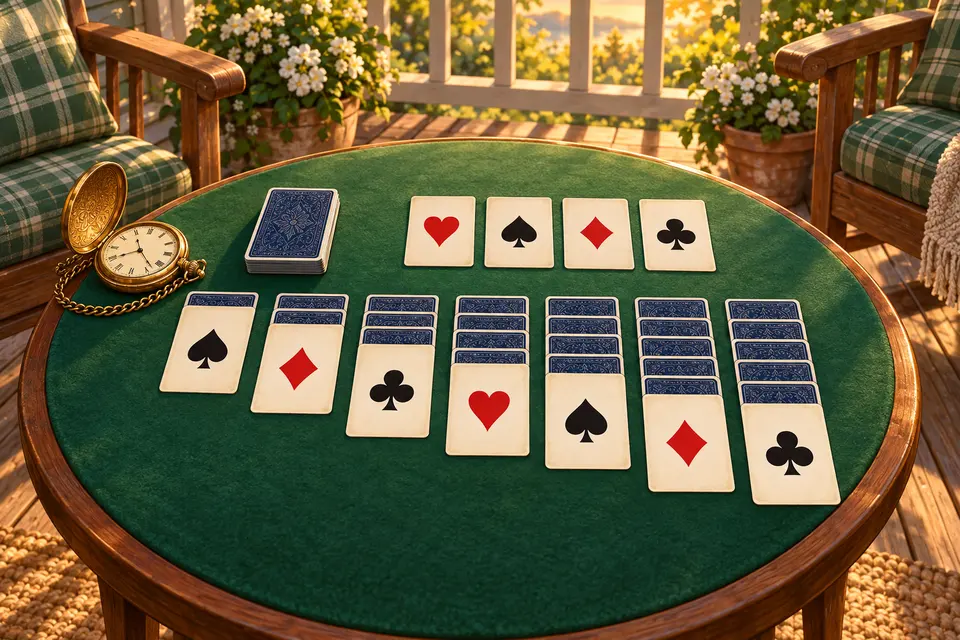
If you’ve played much Solitaire, you know the feeling: you’ve turned the stock over three times, nothing new is coming up, and there’s not a single useful move left. Was that deal ever winnable — or did you miss something?
The honest answer is sometimes one, sometimes the other. Not every game of Klondike Solitaire can be won, but more of them can be won than most people manage. Here’s what’s known about the odds, why the gap exists, and what you can do to close it.
The short answer
No, not all Solitaire games are winnable. Some shuffles bury the cards you need so deeply that no sequence of moves can free them.
But “winnable” can mean two different things, and the difference matters:
- Winnable if you could see every card. A deal is solvable if some sequence of moves wins it — even one you could only find by knowing where every face-down card is.
- Winnable for a real player. In an actual game, 21 cards start face down. You have to make choices without knowing what’s under them, and some of those choices turn out wrong.
The first number is a property of the deck. The second depends on you.
How many Klondike deals can be won?
Computer researchers have studied this by solving huge numbers of deals with every card visible — a version of the game called thoughtful solitaire. For standard Klondike with Draw 3 and unlimited trips through the stock, the best-known estimates say that roughly 82 percent of deals have a solution. Put another way, about one deal in five or six is lost before you make a single move.
Draw 1 deals are winnable at least as often, and in practice more often. When you turn one card at a time, every card in the stock is reachable on every pass, so with unlimited passes, anything you could do in Draw 3 you can also do in Draw 1.
Treat these as approximate figures. They depend on the exact rules — how many passes through the stock you get, whether cards can come back off the foundations — and on how researchers handled deals that were too hard to settle completely.
Why real players win far less often
If about four out of five deals can be won, why does it feel like you lose most of your Draw 3 games? There’s no official statistic for how often people win, and the numbers players report vary a lot. But almost everyone wins well below that 82 percent ceiling, especially at Draw 3. A few reasons:
You can’t see the face-down cards
The solver knows that the 7♣ you need is hiding under the King in column six. You don’t. When you choose which column to work on, which black 8 gets the red 7, or which King moves into an empty column, you’re making an educated guess. A guess that’s wrong now can make the deal unwinnable later.
Some choices can’t be undone
With real cards, once you’ve moved the red 6 onto the wrong black 7 and turned over three more cards, there’s no going back. Many Solitaire losses come from a single fork in the road early in the game that only looks wrong ten moves later.
Draw 3 hides cards from you
In Draw 3, only every third card in the stock is playable on a given pass. The card you need may be sitting second in a group of three, and it will stay out of reach until you play something from the waste to shift the order. That’s why Draw 3 is so much harder: you’re juggling the stock as a puzzle on top of the tableau.
Pass limits make it worse
Under strict rules — one pass in Draw 1, three in Draw 3, as in Vegas scoring — you can’t keep cycling the stock to look for a card. Fewer passes means fewer deals you can realistically win.
How FreeCell compares
If unwinnable deals bother you, try FreeCell. All 52 cards are dealt face up, and nearly every deal can be won. In the original set of 32,000 numbered Windows deals, only one — #11982 — has no solution. A loss in FreeCell is almost always a mistake you can find and fix, which is exactly why some people love it and others find it less relaxing.
How to win more Klondike games
You can’t fix an unwinnable shuffle, but you can stop throwing away winnable ones. These habits make the biggest difference.
1. Start with Draw 1
If your goal is to win more, play Draw 1. It’s the same game with far fewer dead ends, and it teaches you to see the tableau without the stock puzzle getting in the way.
2. Before every move, ask what it turns over
Every move should either flip a face-down card, get a card to a foundation, or set one of those up. Moves that just shuffle face-up cards between columns rarely help.
3. Work the big columns first
The right-hand columns hide the most cards — six under the face-up card in column seven. A move that starts digging into a tall column is usually worth more than one that clears a short one.
4. Choose between twins carefully
Often two cards could take the same spot — both red 7s could go on your black 8, or both black Kings could fill an empty column. Pick the one that frees more face-down cards, or the one whose column you’re trying to clear. This is the decision that most often separates a win from a loss.
5. Don’t empty a column without a plan
An empty column can only take a King. Clear one when a King (ideally with face-down cards under it) is ready to move in, not just because you can.
6. Hold off on the foundations
Aces and twos can always go up. Higher cards are sometimes needed on the tableau to hold a card of the opposite color. If a red 5 still needs a home, keep both black 6s in play until it’s settled.
7. In Draw 3, play the waste on purpose
Playing a card from the waste changes which cards come up on the next pass. If the card you need is stuck in the middle of a group of three, playing one waste card now may bring it to the top next time around.
8. Look before you recycle
When the stock runs out, scan the whole table one more time — including whether a foundation card could come back down to hold something. One overlooked move can unlock the rest of the game.
9. Use undo to learn, not just to escape
When you lose, step back to the last real choice and try the other branch. You’ll quickly start to recognize the decisions that matter.
For the complete rules and scoring, see the Solitaire rules guide.
Want only winnable deals?
On BieGames, Solitaire has a Winnable deals only setting, turned on by default. Each shuffle is checked by a solver before you see it, so you know there’s a way through — you still have to find it. Switch to Any deal if you’d rather play the deck as it falls, and try the daily deal, which is always winnable. It’s free, with unlimited undo and hints, in Draw 1 or Draw 3.
Play these games free
Every game on BieGames runs right in your browser — no download, no sign-up, friendly computer players.