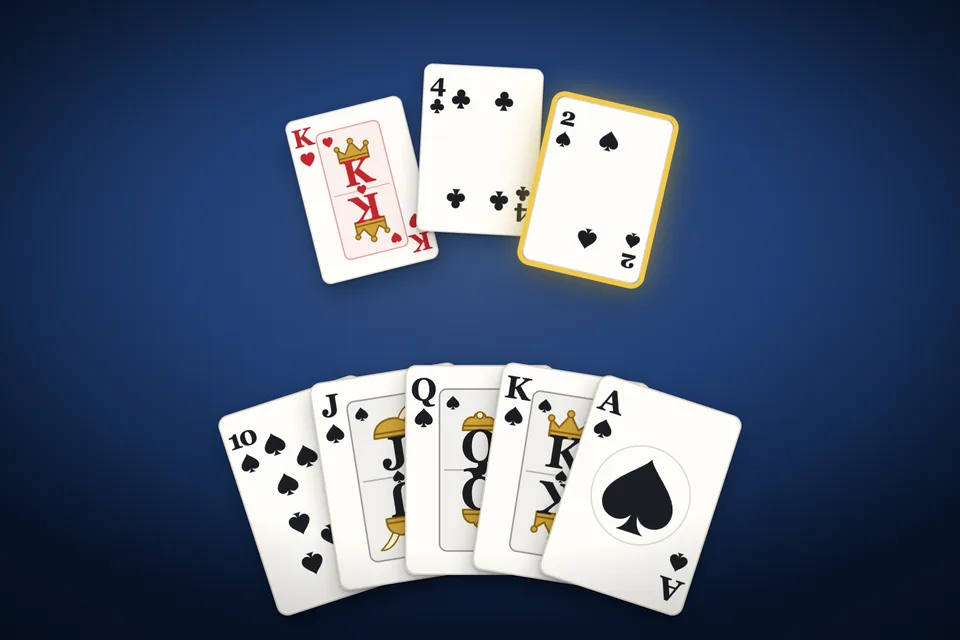
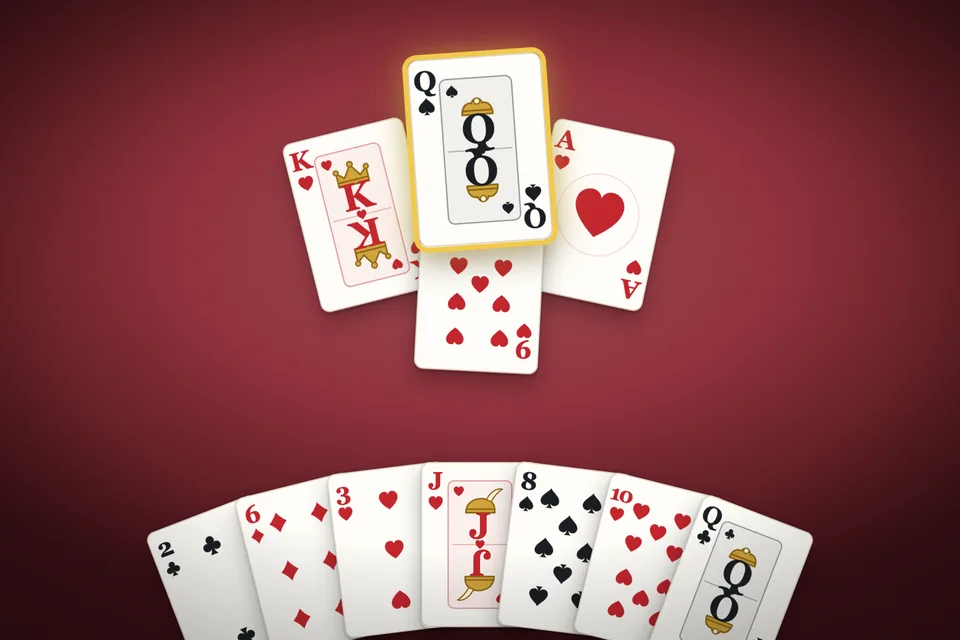
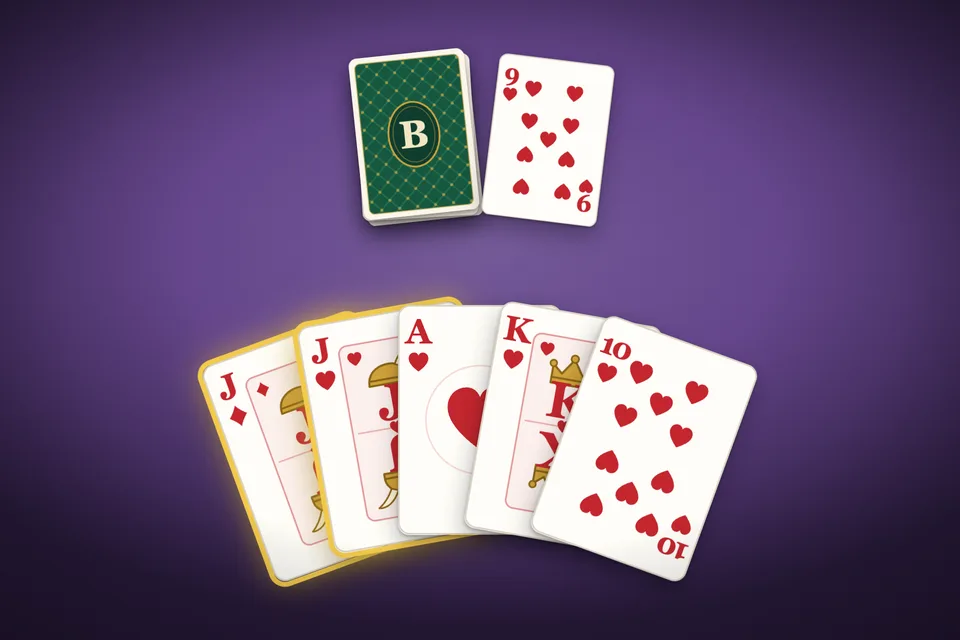
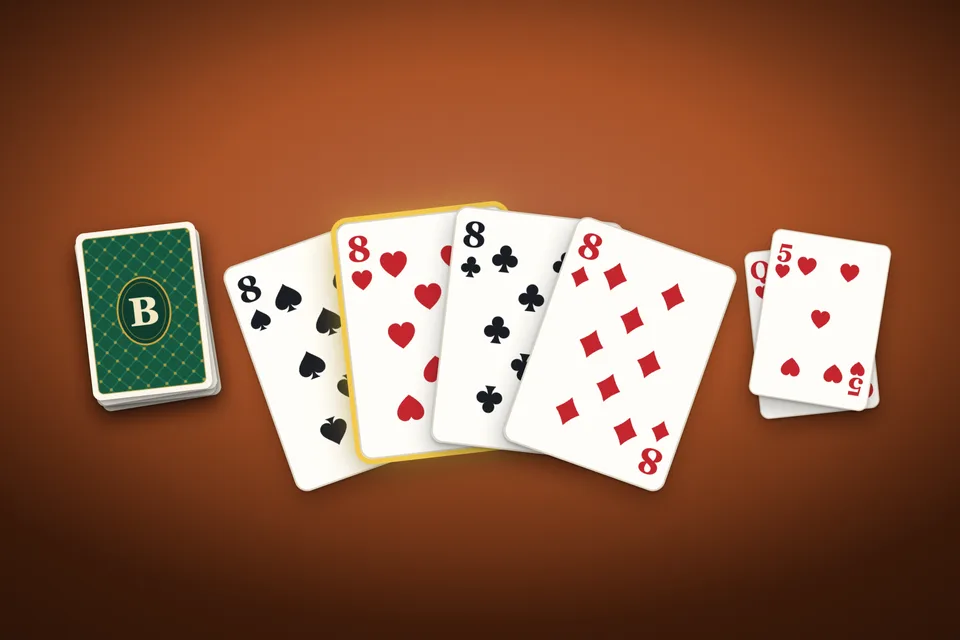
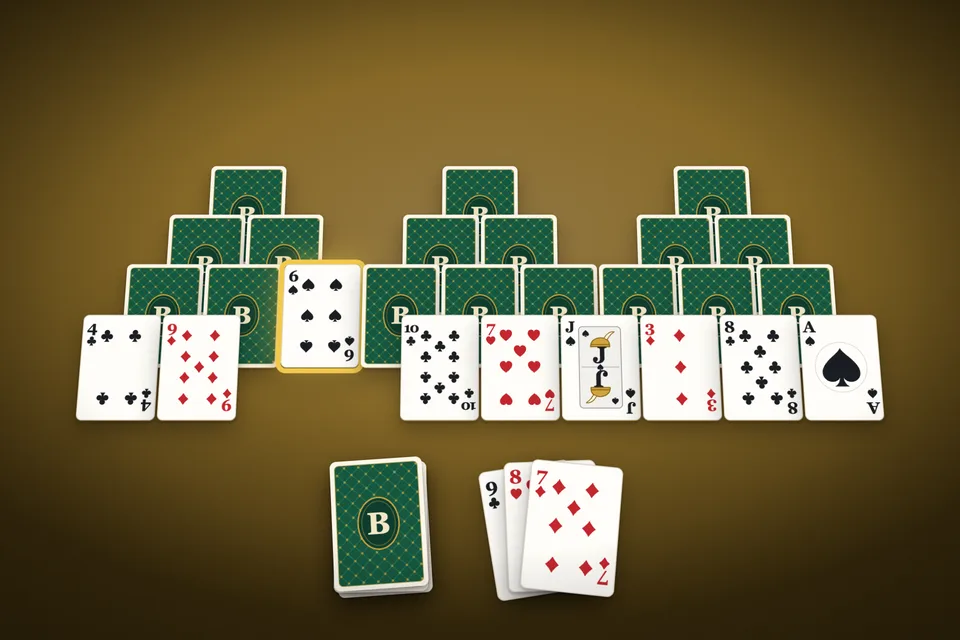
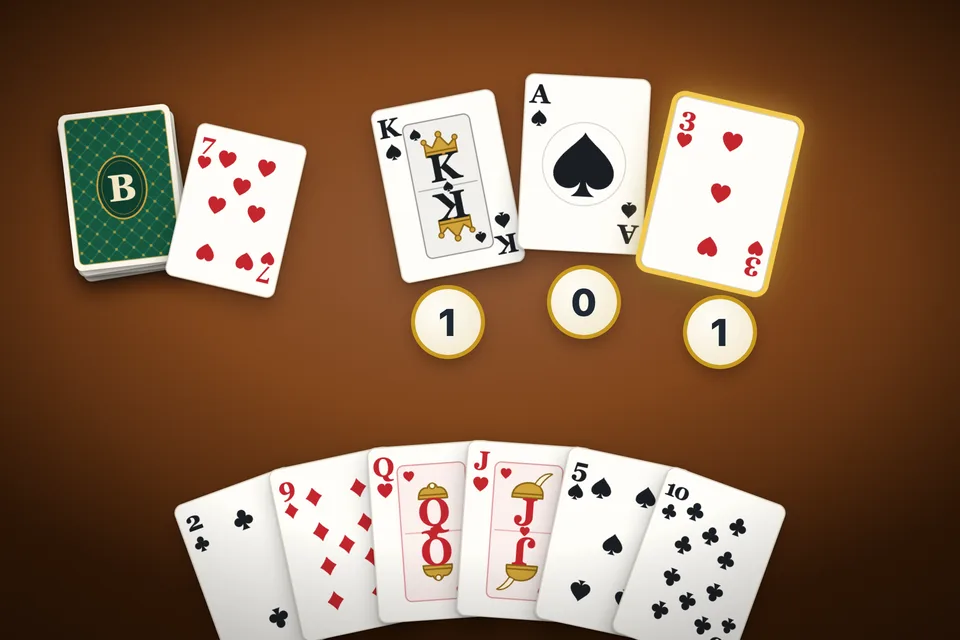
Play Cribbage online free against June, a friendly computer opponent — easy, normal or hard. Discard to the crib, peg your way to 121 on a real cribbage board, and watch every hand counted out loud, fifteen two, fifteen four, so you learn as you play.
How to play Cribbage
This page covers what you need to play your first game. For every rule in detail — cutting for deal, muggins, skunks and the three- and four-player games — read our complete Cribbage rules guide.
Cribbage is a classic two-player card game that has been played for nearly four hundred years, from navy ships to kitchen tables. It mixes a little luck with a lot of skill: you score points by making combinations of cards, and you keep track of them by moving pegs along a cribbage board. The first player to reach 121 points wins. BieGames follows the standard six-card rules for two players described below, so everything you learn here works at any table.
The deal
At the start of the game each player cuts the deck, and the lower card deals first (Aces are low). After that, the deal alternates every hand. The dealer gives six cards to each player, one at a time. The player who isn't dealing is called the pone.
Laying away to the crib
Each player chooses two cards to put face down into the crib — a third hand that belongs to the dealer and is counted at the end. That leaves you four cards. Here, tap two cards to lift them and press Send to crib, or drag them onto the crib.
The cut and his heels
Next the pone cuts the deck and the top card is turned face up. This is the starter (also called the cut card). It isn't played, but it counts as a fifth card in both hands and the crib. If the starter is a Jack, the dealer pegs 2 points right away for his heels.
The play (pegging)
Starting with the pone, players take turns laying one card face up and saying the running total: “seven,” “fifteen,” “twenty-two.” Aces count 1, number cards their face value, and Jacks, Queens and Kings count 10. The count can never go past 31. You score points during the play for:
- Fifteen — making the count exactly 15: 2 points.
- Thirty-one — making the count exactly 31: 2 points.
- Pairs — playing a card of the same rank as the one just played: 2 points. A third one in a row is a pair royal for 6, and a fourth is a double pair royal for 12.
- Runs — when the last three or more cards played form a sequence, in any order: 1 point per card. A 4, then a 6, then a 5 is a run of three.
If you can't play without going over 31, you say “Go.” Your opponent keeps playing as long as they can, then pegs 1 point for the go (or 2 if they hit 31 exactly). The count goes back to zero and the next player starts a new count. Whoever plays the very last card of the hand pegs 1 point for last card.
The show (counting the hands)
After all the cards are played, the hands are counted, each together with the starter. The pone always counts first, then the dealer counts their hand, and finally the dealer counts the crib. Order matters: if the pone reaches 121 with their hand, the game is over before the dealer counts at all. Here every hand is counted out loud for you — the cards light up one combination at a time and the points are listed underneath.
Cribbage scoring and counting
Counting a cribbage hand looks tricky at first, but it's always the same five things, in the same order. Look at your four cards plus the starter:
| Combination | Points | Example |
|---|---|---|
| Fifteen — any cards adding up to 15 | 2 each | 7 + 8, or 5 + K, or 2 + 3 + K |
| Pair — two cards of the same rank | 2 each | 9♠ 9♥ (three of a kind is three pairs: 6) |
| Run — three or more ranks in a row | 1 per card | 4 5 6 (Aces are low: A-2-3 is a run, Q-K-A is not) |
| Flush — all four hand cards the same suit | 4, or 5 if the starter matches | In the crib, only a five-card flush counts |
| His nobs — the Jack of the starter's suit | 1 | J♦ in your hand with a ♦ starter |
Every different combination counts, and a card can be used in many of them. That's where big hands come from. Players count aloud with a running total: “fifteen two, fifteen four, and a pair is six.”
Counting examples
- 5♠ 5♥ K♦ 2♣ with a 9♣ starter: each 5 makes fifteen with the King (fifteen two, fifteen four), and the two 5s are a pair — 6 points.
- 4♣ 5♦ 5♥ 6♠ with a 9♣ starter: 6 + 9 and two ways to make 4 + 5 + 6 are three fifteens (6), the 5s are a pair (8), and there are two runs of 4-5-6 (14) — a double run worth 14 points.
- The 29 hand: three 5s and the Jack, with the fourth 5 turned up in the Jack's suit. Eight fifteens (16), six pairs among the four 5s (28) and his nobs make 29, the highest score possible. It shows up roughly once in every 216,000 hands, so if you get one here, there's an achievement waiting.
Some totals can't be made at all: no hand can score 19, 25, 26 or 27. That's why players jokingly call a hand worth nothing a “nineteen.”
For more worked examples, including double runs and the fifteens people miss, see how to count a cribbage hand. To check a count of your own, try our cribbage hand calculator.
Pegging points at a glance
During the play: 15 or 31 is 2 points, a pair 2, a pair royal 6, a double pair royal 12, a run 1 per card, a go 1 and last card 1. His heels — a Jack turned up as the starter — gives the dealer 2.
The cribbage board and skunks
Cribbage is famous for its board: a long track of holes, usually 120 plus a finishing hole, where each player moves two pegs. The board above the cards works just like a wooden one. Your track is on the bottom, June's is on the top, each going out along the outer row and back along the inner row to the game hole at 121.
Each player has two pegs. When you score, the back peg jumps ahead of the front one by the number of points. The gap between your pegs always shows your last score, which is how players catch counting mistakes at a real table. Your exact score is also shown in numbers at the left end of the board and at the top of the game.
Skunks
If you win before your opponent reaches 91 points, they're skunked; if they haven't reached 61, it's a double skunk. Many players count a skunk as two games won. Here a skunk is announced at the end of the game and earns its own achievement — try to skunk June on Hard.
Short games
In Settings you can choose a short game to 61 instead of 121 — the length the older five-card game was played to. In a short game, holding your opponent under 31 is a skunk.
Cribbage strategy tips
Discarding: whose crib is it?
The most important decision in every hand is which two cards to lay away, and the answer depends on whose crib it is.
- Your crib (you're the dealer): the crib's points are yours, so you can throw cards that work together. A pair, two cards that make fifteen (7-8, 6-9, 5-10), a pair of 5s, or two cards close in rank all make the crib stronger. If it's a toss-up, favor your crib.
- June's crib (you're the pone): every point in the crib goes to her, so throw cards that don't help each other — far apart in rank and in different suits, like a King and a 2, or a 9 and an Ace. Never give your opponent a 5 if you can help it: with sixteen ten-cards in the deck, a 5 is the best card in cribbage.
Keep the hand, not the cards
Count what your four kept cards are worth, then think about the starter: 4-5-6 is good now and great if a 5 or a ten-card turns up. Cards that are close together (6-7-8-9) and cards that make fifteen with tens (5s) catch more starters than scattered high cards. The Hint button shows the choice June's Hard player would make, worked out over every possible starter. Our guide to what to throw in the crib works through real hands from both seats.
Pegging tips
- Lead low. A card under 5 is a safe lead: your opponent can't make fifteen with one card. Never lead a 5.
- Lead from a pair. If you hold two 8s and your opponent pairs your first 8, you can answer with a pair royal for 6.
- Avoid 5 and 21. A count of 5 or 21 lets a ten-card make 15 or 31.
- Watch for runs. Playing a card one or two away from your opponent's card can set them up for a run. Sometimes that's a trap you can spring back.
- Save low cards for late in the count. An Ace or a 2 near 31 squeezes in an extra card and wins the go.
Play to the board
Near the end of a game, think about the board, not just the hand. With good discards an average hand is worth about 8 points and an average crib about 4 or 5, so the dealer usually scores more in a hand than the pone. If you're the pone and need only a few points, remember that you count first: play safe in the pegging and let your hand take you home. If you're far behind, take more chances.
Looking for another two-player classic? Gin Rummy is the other great head-to-head card game, and our list of the best 2-player card games has more ideas.
Computer difficulty and daily deal
- Easy — June plays like someone learning the game: she keeps the cards that look best on their own, doesn't think about the crib, and pegs on a whim.
- Normal — sound, steady play: she works out what each discard is worth over every possible starter, guards your crib, and pegs safely.
- Hard — June estimates the crib much more closely, keeps low cards for pegging, and before every play weighs what you could peg back with the cards she hasn't seen. She never peeks at your hand or the deck.
Change the level in Settings; it takes effect with the next game, and your stats are kept for each level. Press Daily to play the day's deal — the same cards for everyone today — and build a daily streak. You can undo laying away to the crib until the deck is cut, and undo cards you play while June has said go. Your game saves itself, so you can close the page and come back later.
On a keyboard, press 1–6 to pick a card from your hand, Enter for the highlighted button (send to crib, cut, continue), G to say go, H for a hint and Ctrl+Z (⌘Z on a Mac) to undo. Tab and the arrow keys move between your cards.
Want every detail, with examples and the common house rules? Read our complete Cribbage rules guide.
Cribbage FAQ
How do you play cribbage against the computer?
Pick two of your six cards for the crib, then take turns with June laying cards and adding up the count to 31, scoring for fifteens, pairs, runs and gos. When the cards are played, both hands and the crib are counted with the starter card. Every count is shown step by step, and Hint suggests a move whenever you want one.
What is the highest hand in cribbage?
Twenty-nine: three 5s and the Jack in hand, with the fourth 5 turned up as the starter in the same suit as the Jack. It scores eight fifteens, six pairs and his nobs.
Why is there no 19 hand in cribbage?
Because no possible combination of four cards and a starter scores exactly 19 points. Scores of 25, 26 and 27 are impossible too. That is why players jokingly say “nineteen” when a hand scores nothing at all.
Does a flush count in the crib?
Only a five-card flush. In your hand, four cards of one suit score 4 points (5 if the starter matches too), but the crib scores a flush only when all four crib cards and the starter are the same suit.
What is his nobs and his heels?
His nobs is the Jack of the same suit as the starter, held in your hand or crib: it scores 1 point in the show. His heels is when the starter itself is a Jack: the dealer pegs 2 points right away.
What happens if a Jack is cut in cribbage?
If the starter turned up after the discard is a Jack, the dealer pegs 2 points right away for his heels. It is scored before any cards are played, so a dealer who needs only 2 points wins on the spot. A Jack turned up when cutting to decide who deals first scores nothing.
What should I throw in the crib?
It depends on whose crib it is. In your own crib, throw cards that score together, like a 5 with a ten-card, a pair or a 7 and 8. In your opponent’s crib, throw cards that don’t help each other, like a King and a 9, and never a 5 if you can help it. Our guide to cribbage discard strategy walks through real hands.
What is muggins in cribbage?
Muggins is an optional rule: if a player misses points in their count, the opponent may call “muggins” and peg those points for themselves. On BieGames every hand is counted for you, so no points are ever missed and there is no muggins.
What does “go” mean in cribbage?
If you can't play a card without taking the count past 31, you say go. Your opponent plays any cards they can, then scores 1 point for the go (or 2 for reaching exactly 31), and a new count starts from zero.
What is a skunk in cribbage?
Winning before your opponent reaches 91 points is a skunk, and before they reach 61 is a double skunk. Many players count a skunk as two wins. Here a skunk is announced at the end of the game and unlocks an achievement.
Who counts first in cribbage?
The pone — the player who didn't deal — always counts first, then the dealer counts their hand, then the dealer counts the crib. The game ends the moment someone reaches 121, so near the finish the pone's head start can decide the game.
Can I play cribbage online free on my phone?
Yes. This cribbage game runs in any modern browser on phones, tablets and computers, with nothing to install and no sign-up. The board, cards and counts are sized for small screens, and your game saves automatically so you can pick up where you left off.