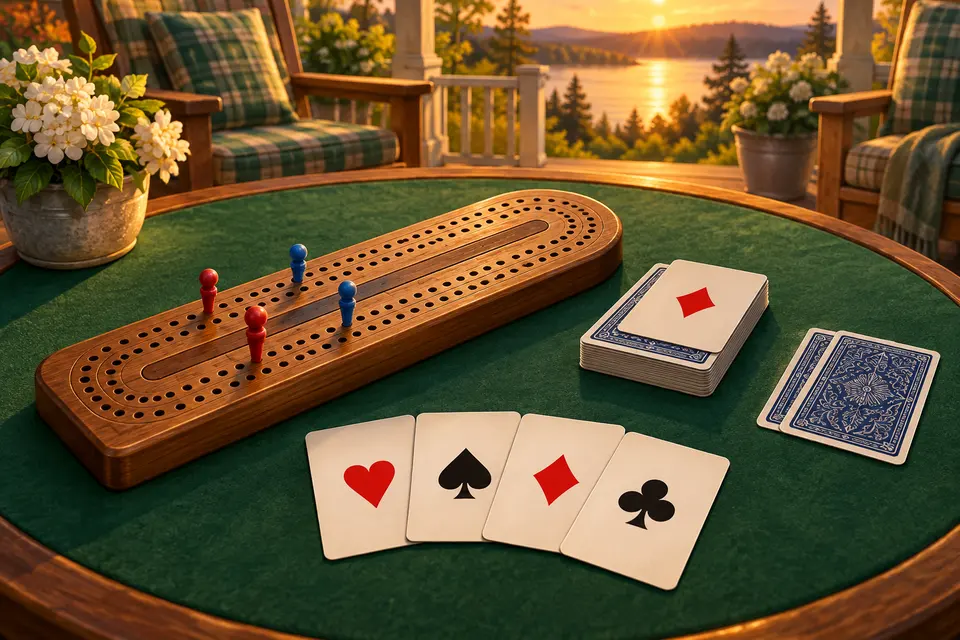
Counting is the part of Cribbage that scares people off, and it’s also the part that makes the game so satisfying once it clicks. The good news: there are only five things to look for, and you always look for them in the same order.
This guide walks through each scoring combination, then counts real hands step by step — including the famous 29 — and finishes with the traps that catch even experienced players.
What you count
Every hand is counted together with the starter (also called the cut card): the card the dealer turns face up before play begins. Your four cards plus the starter make five cards, and you score every combination you can find among them.
| Combination | Points |
|---|---|
| Fifteen — any group of cards adding up to 15 | 2 for each different group |
| Pair — two cards of the same rank | 2 (three of a kind = 6, four of a kind = 12) |
| Run — three or more cards in sequence, any suits | 1 per card |
| Flush — all four hand cards the same suit | 4, or 5 if the starter matches too |
| Nobs — the Jack of the same suit as the starter | 1 |
The crib is counted the same way, with one exception for flushes (see below).
Fifteens
For fifteens, an Ace is 1, number cards are their face value, and Jacks, Queens and Kings are all 10.
Look for every different group of cards that adds to 15 — two cards, three, four or even all five. Each different group scores 2. A card can be used in more than one fifteen, as long as the groups aren’t identical.
7 + 8 = 15. 5 + K = 15. 2 + 4 + 9 = 15. A + 2 + 3 + 9 = 15.
The most common miss is a fifteen made of three or more cards. When you think you’re done, check once more for small cards that add up together.
Pairs
Every pair of cards with the same rank scores 2. Three of a kind contains three different pairs, so it’s worth 6 (a pair royal). Four of a kind contains six pairs, worth 12 (a double pair royal).
Only ranks count: a Jack and a Queen are both worth 10 for fifteens, but they are not a pair.
Runs
A run is three or more cards in consecutive rank, in any suits: 5-6-7 or 9-10-J-Q. It scores 1 point per card. Aces are always low, so A-2-3 is a run but Q-K-A is not.
Score only the longest run. A run of four (4 points) is not also two runs of three.
Double, triple and double-double runs
When a run includes a pair, you have two separate runs. Counting them correctly is where most beginners lose points, so it helps to memorize these totals (runs and pairs only, not counting fifteens):
| Pattern | Example | Runs + pairs |
|---|---|---|
| Double run of three | 4-5-5-6 | 8 (two runs of 3, one pair) |
| Double run of four | 4-5-6-6-7 | 10 (two runs of 4, one pair) |
| Triple run | 6-7-8-8-8 | 15 (three runs of 3, a pair royal) |
| Double-double run | 7-7-8-8-9 | 16 (four runs of 3, two pairs) |
Flushes
If all four cards in your hand are the same suit, that’s a flush worth 4. If the starter is the same suit too, it’s worth 5.
The crib is stricter. A crib only scores a flush when all five cards — the four crib cards and the starter — are the same suit, for 5 points. Four of a suit in the crib scores nothing.
Three hand cards plus a matching starter is never a flush, in a hand or a crib.
Nobs
If you hold the Jack of the same suit as the starter, you score 1 for nobs (sometimes called “his nob” or “one for his nob”).
Don’t confuse it with his heels: when the starter itself is a Jack, the dealer immediately pegs 2. That happens when the card is cut, not during the count.
The counting order
After the play is over, hands are counted in this order:
- The non-dealer (the pone) counts their hand first.
- The dealer counts their hand.
- The dealer counts the crib.
The order matters near the end of the game: if the non-dealer reaches 121 first, they win, even if the dealer’s hand and crib would have scored more.
Within a hand, most players count in the same order every time — fifteens, then pairs, then runs, then flush, then nobs — and say it out loud: “Fifteen two, fifteen four, and a pair is six.” A steady routine keeps you from missing points.
Worked examples
Example 1: a run of four and three fifteens
Hand: 6♣ 7♦ 8♥ 9♠ · Starter: 2♣
Fifteens: 6 + 9, 7 + 8, and 6 + 7 + 2 — three fifteens for 6. Run of four, 6-7-8-9, for 4. No pairs, no flush. Total: 10.
Example 2: a double run
Hand: 4♦ 5♣ 5♥ 6♠ · Starter: K♣
Fifteens: 4 + 5 + 6 with each 5 (two), and K + 5 with each 5 (two) — 8. Pair of fives — 2. Double run, 4-5-6 twice — 6. Total: 16.
Example 3: nobs and a run of face cards
Hand: J♦ Q♣ K♥ 5♠ · Starter: 5♦
Fifteens: each of the J, Q and K with each 5 — six fifteens for 12. Pair of fives — 2. Run of J-Q-K — 3. The J♦ matches the starter’s suit — 1 for nobs. Total: 18.
Example 4: a double-double run
Hand: 7♣ 7♦ 8♥ 8♠ · Starter: 9♣
Fifteens: each 7 with each 8 — four fifteens for 8. Two pairs — 4. Four runs of 7-8-9 — 12. Total: 24.
Example 5: a flush, in a hand and in a crib
Hand: 2♥ 6♥ 9♥ Q♥ · Starter: K♠
Fifteens: 6 + 9 — 2. Four hearts in hand — 4 for the flush. Total: 6.
If these same five cards were the crib, there would be no flush: the crib needs five of a suit. Crib total: 2. Change the starter to the 4♥ and the crib now has 6 + 9 and 2 + 4 + 9 for 4 points plus a five-card flush for 5 — crib total: 9.
Example 6: the perfect 29
Hand: 5♥ 5♣ 5♠ J♦ · Starter: 5♦
Fifteens: the Jack with each of the four fives (four fifteens), plus every group of three fives (four more) — eight fifteens for 16. Four of a kind — 12. The J♦ matches the starter — 1 for nobs. Total: 29, the highest hand in Cribbage.
Common counting traps
- Counting a four-card flush in the crib. The crib needs all five cards in one suit.
- Scoring two runs of three inside a run of four. Only the longest run counts — unless a pair creates a true double run.
- Forgetting multi-card fifteens. Always check for groups of three and four cards.
- Calling Q-K-A a run. Aces are low only.
- Mixing up nobs and his heels. Nobs is a Jack in your hand matching the starter (1 point). His heels is a Jack turned as the starter (2 points to the dealer).
- Treating face cards as a pair. J and Q are both 10 for fifteens, but they don’t pair.
- Claiming a 19. It’s impossible to score exactly 19 with a cribbage hand — and 25, 26 and 27 are impossible too. That’s why players jokingly call a hand worth nothing “a nineteen.”
Example of a nineteen. Hand: A♣ 3♦ 7♥ 9♠ · Starter: Q♣. Check every group: nothing adds to 15, there are no pairs, no runs, no flush and no Jack. Total: zero.
Muggins
Some tables play muggins: if a player misses points in their count, the opponent may call “muggins” and peg those points for themselves. It’s an optional rule, and it’s a great incentive to count carefully. Agree before you start whether you’re playing it.
Practice makes it automatic
The first few hands take a while to count. After a dozen games, you’ll start to recognize common patterns at a glance: “4-5-5-6 is 8 before fifteens,” “every 5 with a face card is another fifteen-two.” That’s when Cribbage really starts to flow.
For the full game — dealing, discarding to the crib, the play to 31 and pegging to 121 — see the Cribbage rules. To check your counting, try the cribbage hand calculator, and when you’re ready to choose better keeps, read what to throw in the crib. If Cribbage is new to you, our list of the best 2-player card games shows how it compares to other two-player classics. And when you’d like to practice counting without a board or a deck, you can play Cribbage free in your browser.
Play Cribbage free
Every game on BieGames runs right in your browser — no download, no sign-up, friendly computer players.