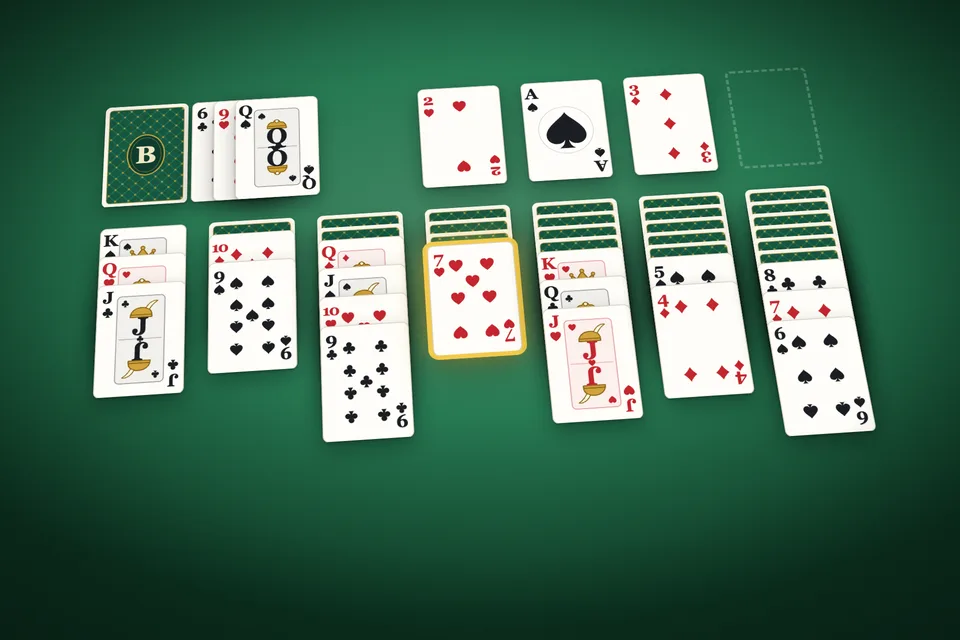
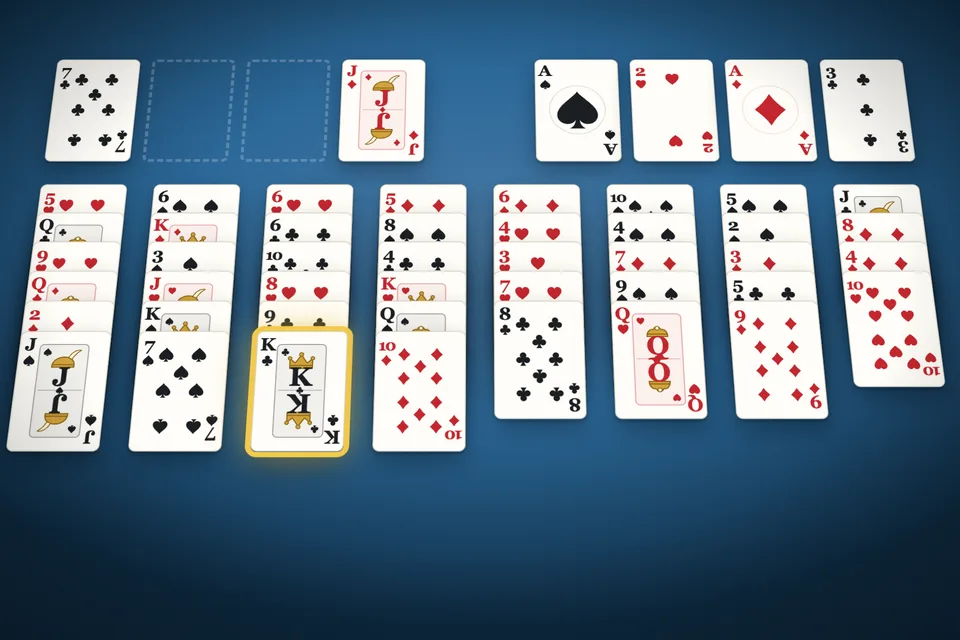
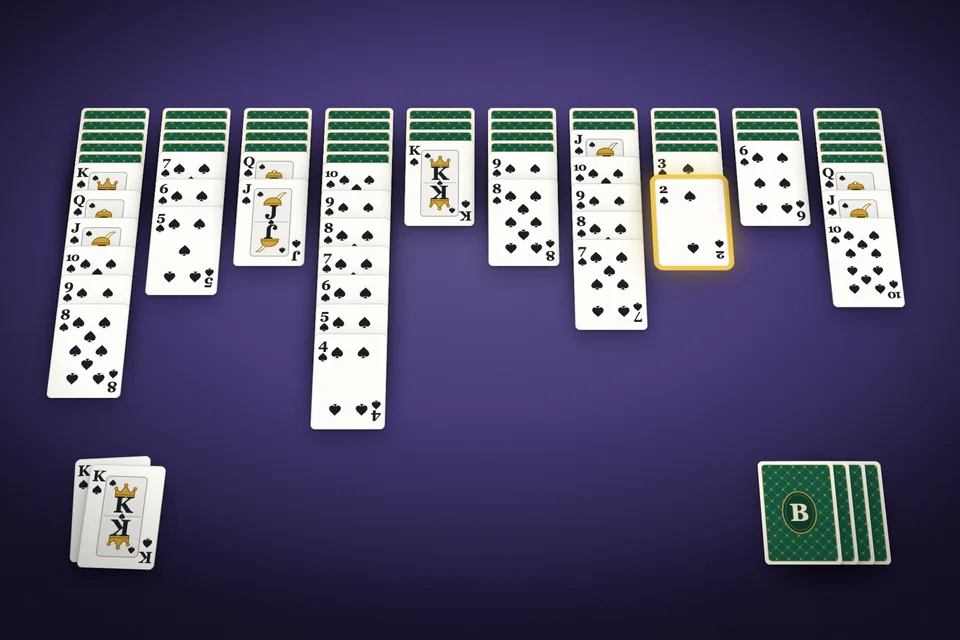
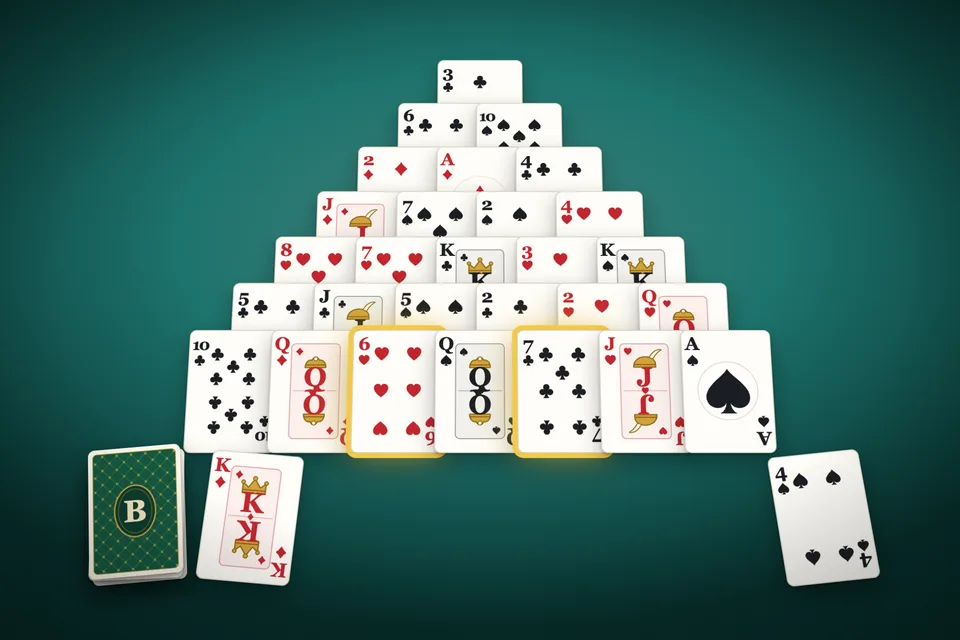
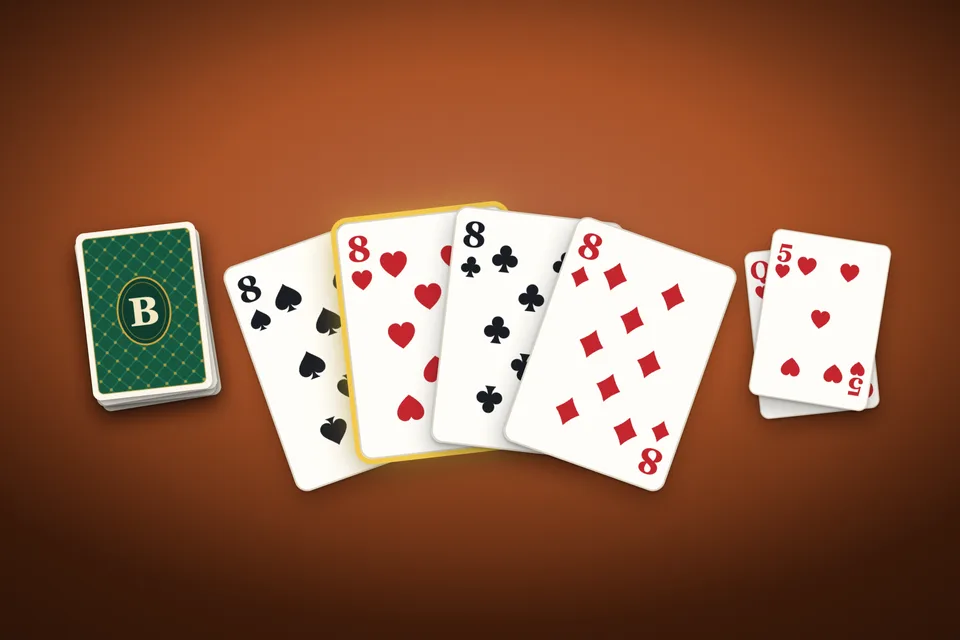
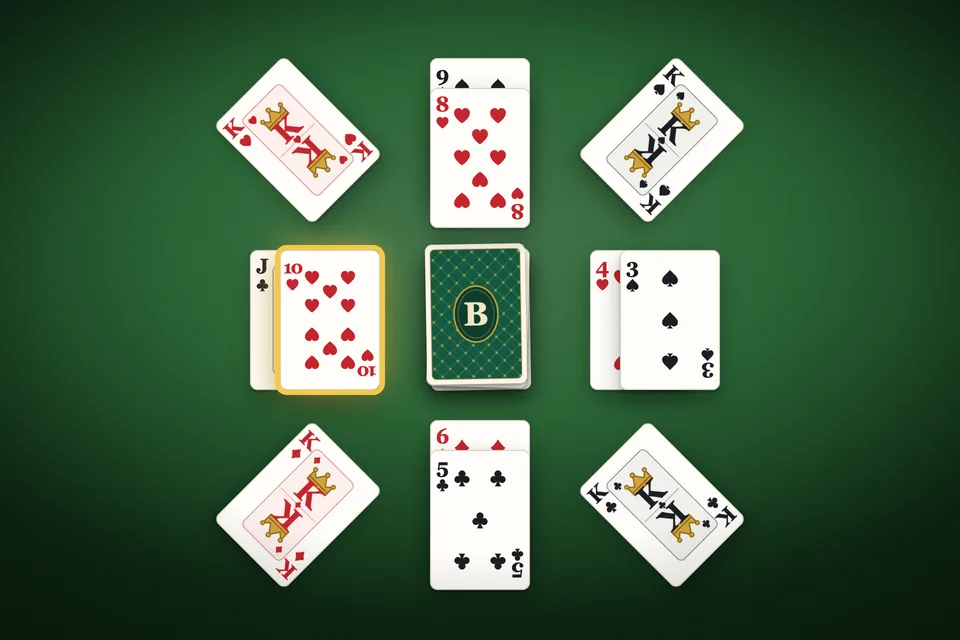
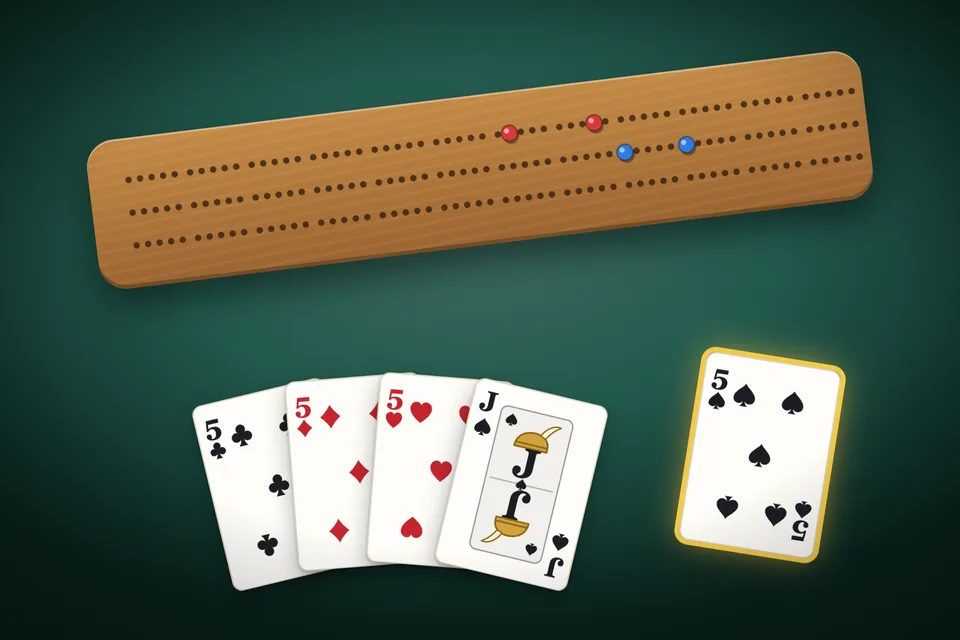
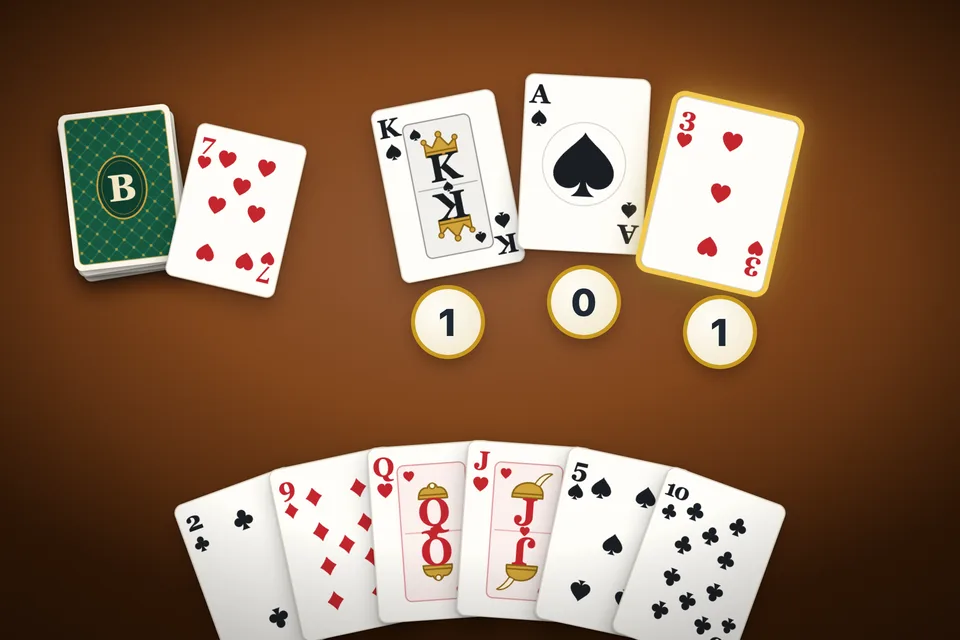
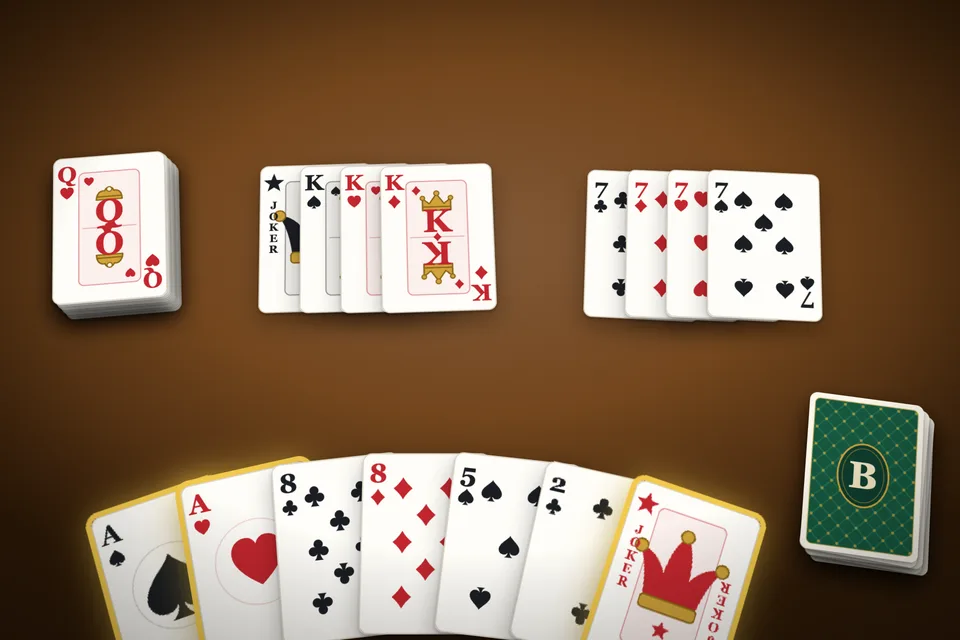
Play Scorpion Solitaire online free in your browser. Build four King-to-Ace runs in suit, moving any face-up card with everything on top of it — with winnable deals, smart hints, unlimited undo, the Wasp variant and a new daily deal every day.
How to play Scorpion Solitaire
Scorpion Solitaire — Scorpion patience in British English — is a one-player game for a single 52-card deck. Your goal is to sort the whole deck into four complete runs, each going from King down to Ace in one suit. It belongs to the Spider family of solitaire games, but it moves cards the way Yukon does: any face-up card can be picked up, together with every card lying on top of it.
The layout
- The tableau is seven columns of seven cards, 49 in all. In the first four columns the three bottom cards are face down and the four on top are face up. The last three columns are face up from top to bottom.
- The stock holds the three cards left over. They wait face down until you deal them, once per game.
- The foundations are the four spaces for finished runs. You never build on them yourself: a complete King-to-Ace run moves there on its own.
Moving cards
- Build down in suit. A card can only go on the next higher card of its own suit, and only at the end of a column: the 6♥ on the 7♥, the Jack of Clubs on the Queen of Clubs. Nothing can go on an Ace.
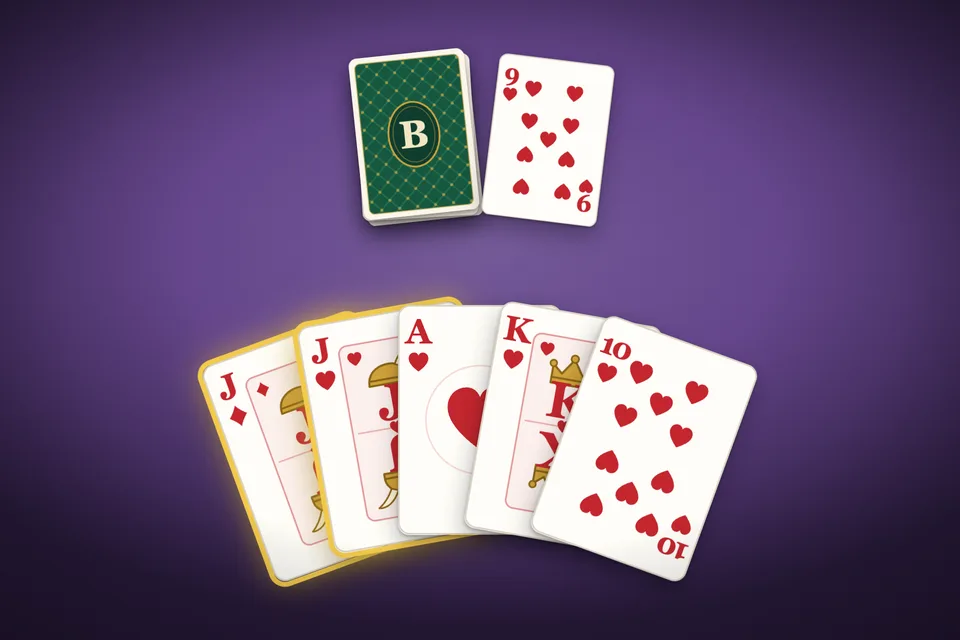
- Move any face-up card. You are not limited to the last card of a column. Pick up any face-up card and every card on top of it comes along, whether or not those cards are in order. If the 9♦ has the 4♣ and the K♦ sitting on it, the three move together onto the 10♦.
- Only Kings fill empty columns. When a column is cleared, only a King — with whatever is on top of it — can move into the space. (The Wasp rule, described below, lets any card in.)
- Turn over hidden cards. When the last face-up card leaves one of the first four columns, the face-down card under it turns over and joins the game.
The three extra cards
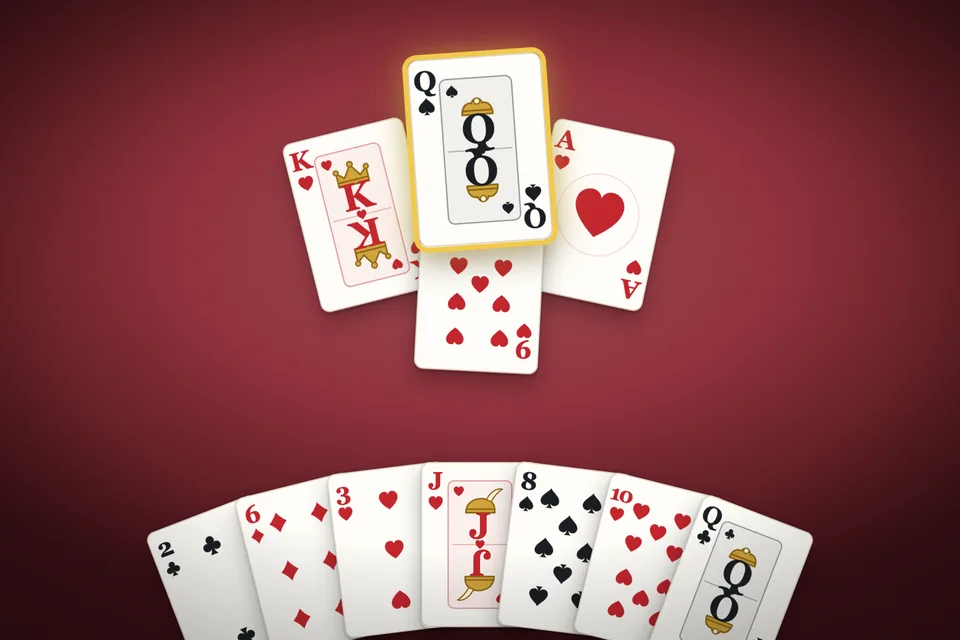
Once per game you may deal the stock: its three cards go face up onto the ends of the first three columns, one each. With real cards, players usually wait until they are out of moves. On BieGames you can deal whenever you like, but only once, so it pays to choose the moment.
Finished runs and winning
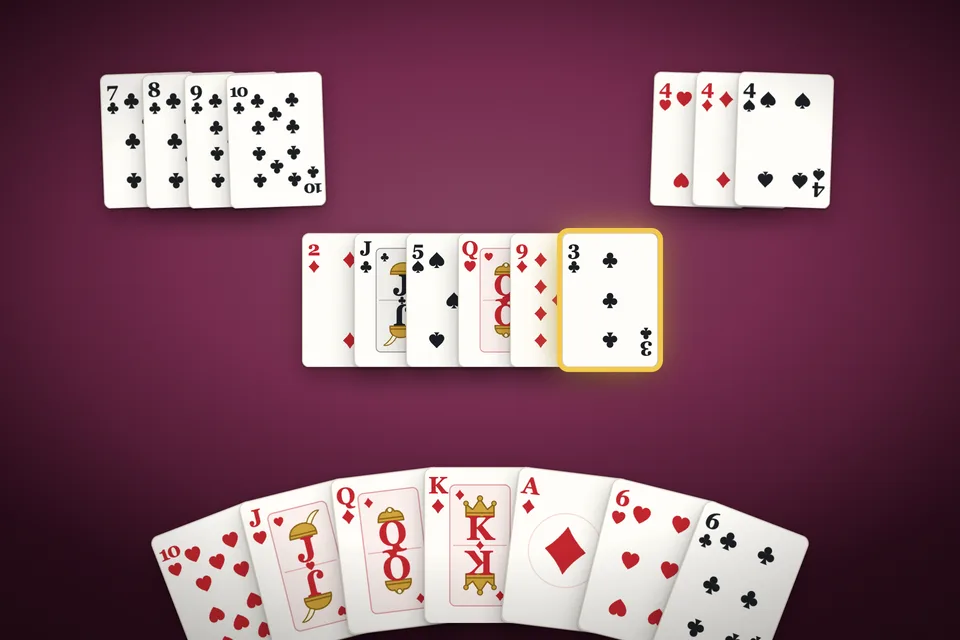
As soon as a column ends with all thirteen cards of one suit from King down to Ace, the run lifts off the table and lands in the foundations, and any card it was covering is uncovered. Finish all four runs and you win. If the extra cards are dealt and nothing you can do brings a run closer, the game is lost — undo a few moves to try another path, or start a new deal.
Playing on BieGames
Drag a card and drop it where it goes; the cards on top of it travel along. Or simply tap a card: it jumps to the next higher card of its suit if that card is free, and a King jumps into an empty column. Prefer to choose the spot yourself? Switch Tapping a card to Selects it in Settings. Tap the stock, or press the Deal button, to deal the three extra cards.
On a keyboard, press 1–7 to pick up a column's deepest card that can move and a second number to drop it, D to deal, H for a hint, Esc to let go, and Ctrl+Z (⌘Z on a Mac) to undo. Tab, the arrow keys, Enter and Space work too. Your game saves itself as you play, so you can close the page and pick it up later.
Scorpion Solitaire scoring
Scorpion has no traditional score: with real cards you simply win or lose. To give you something to beat, BieGames keeps score the way classic Windows Spider does:
| Event | Points |
|---|---|
| Starting score | 500 |
| Each move, including dealing the three extra cards | −1 |
| Each undo | −1 |
| Each finished King-to-Ace run | +100 |
A won game always collects 400 points for its four runs, so your final score is 900 minus the moves you made. Fewer moves means a higher score. Your best score, fastest time and fewest moves are kept separately for Scorpion and for Wasp.
Scorpion Solitaire strategy tips
- Uncover the face-down cards first. Twelve cards start hidden in the first four columns, and any of them could be the card you need. When you have a choice, make the move that turns one over.
- Mind the Kings. A King at the head of a column is exactly where it belongs. A King sitting on other cards can only leave through an empty column, so everything beneath it stays stuck until you clear one.
- Choose which King gets the empty column. Under the standard rule an empty column takes only a King, and you may not get another. Give it to the King that is trapping the most cards — especially face-down ones.
- Look at what rides along. Every move carries the cards on top with it. Before you move a card from deep in a column, check where its passengers will end up and whether they will block anything there.
- Untangle cards buried above their home. If the 7♠ sits a few cards above the 8♠ in the same column, it can't reach the 8♠ until the cards between them move away. Free those first.
- Watch for crossed pairs. If the 10♠ lies on the J♣ while the 10♣ lies on the J♠, each one is waiting for the other to move, and under the Kings-only rule neither ever will. When you spot a knot like that, undo and look for a different line.
- Pick your moment for the deal. The three extra cards cover the ends of the first three columns. Deal when those columns end in cards that nothing needs soon — an Ace is ideal, since nothing goes on it — and when you have made the moves you can.
- Lean on Hint and Undo. Undo is unlimited, so try a line and step back if it goes nowhere. Hint looks several moves ahead without peeking at face-down cards or the stock; press it again for the next idea.
Scorpion vs. Wasp and Spider
Wasp solitaire
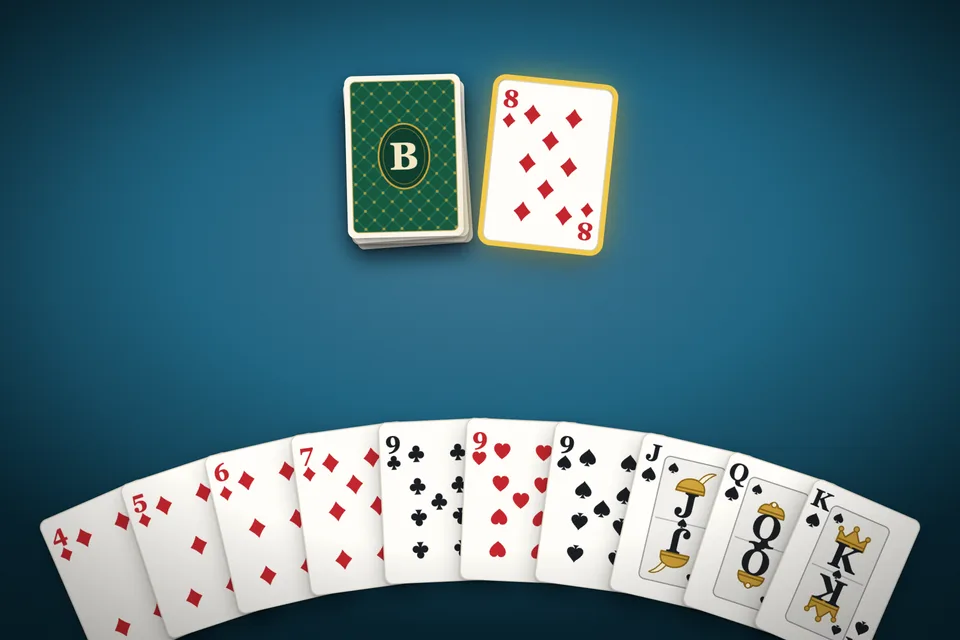
Wasp is Scorpion with one rule changed: any card, with whatever is on top of it, may move into an empty column, not just a King. That one change makes empty columns far more useful and the game noticeably easier. Choose Empty columns: Any card (Wasp) in Settings to play it.
Scorpion II
A gentler version starts with face-down cards in only the first three columns instead of four. Everything else is the same.
How Scorpion differs from Spider
| Scorpion | Spider | |
|---|---|---|
| Cards | One 52-card deck | 104 cards (two decks' worth) |
| Building | Down in suit only | Down in any suit |
| Moving groups | Any face-up card, with everything on top, in order or not | Only a run in one suit |
| Empty columns | Kings only | Any card or run |
| Stock | Three cards, dealt once | Five deals of ten cards |
| Goal | Four King-to-Ace runs | Eight King-to-Ace runs |
If you enjoy Scorpion, try Spider Solitaire for longer games with the same King-to-Ace goal, or FreeCell, where every card is face up from the start.
Winnable deals
Plenty of Scorpion shuffles can't be won however well you play — a crossed pair in the deal, or a key card buried in the wrong place, can end a game before it starts. So by default BieGames only deals games that can be won: before you see the cards, a solver checks that a winning line exists. Finding it is still up to you, since the face-down cards and the stock stay hidden. If you like the full gamble, choose Deals: Any deal in Settings. The daily deal is always a winnable one.
Want every detail, with examples and the common house rules? Read our complete Scorpion Solitaire rules guide.
Scorpion Solitaire FAQ
Is Scorpion Solitaire free to play?
Yes. Scorpion Solitaire on BieGames is completely free, with no download and no sign-up. It works in any modern browser on phones, tablets and computers, and your game is saved automatically so you can come back to it later.
How do you play Scorpion Solitaire?
Deal seven columns of seven cards, with the bottom three cards of the first four columns face down, and keep three cards aside. Move any face-up card, with everything on top of it, onto the next higher card of the same suit at the end of a column. Only Kings may fill an empty column. Deal the three spare cards onto the first three columns once, and win by building four runs from King down to Ace in suit.
What is the difference between Scorpion and Wasp solitaire?
Only the empty-column rule. In Scorpion, just a King (with the cards on top of it) can move into an empty column. In Wasp, any card can. Wasp is the easier of the two, and you can switch between them in Settings.
Do the cards I move have to be in order?
No. That is the twist in Scorpion: the card you pick up must go on the next higher card of its own suit, but the cards on top of it simply come along for the ride, in any order.
Can every game of Scorpion Solitaire be won?
No. Many shuffles can’t be won at all — for example when two cards each sit on the other’s home card. That is why BieGames deals only winnable games by default. You can switch to any deal in Settings if you prefer.
When should I deal the three extra cards?
Usually when you have run out of useful moves, because the three cards cover the ends of the first three columns. Before you deal, try to leave cards there that nothing needs soon, such as an Ace. You can only deal them once.
Is Scorpion harder than Spider Solitaire?
It is a different kind of hard. Scorpion uses one deck and lets you move any face-up card, which Spider doesn’t. But you may only build in suit and only Kings fill empty columns, so one card in the wrong place can lock a whole column. Plan ahead, and use Undo freely while you learn.
How is Scorpion Solitaire scored?
Real-card Scorpion has no score, so BieGames uses the familiar Spider scoring: you start with 500 points, every move, deal and undo costs one point, and every finished King-to-Ace run earns 100. A won game scores 900 minus the number of moves you made.
Is Scorpion patience the same game as Scorpion Solitaire?
Yes. Patience is the traditional British name for solitaire card games, so Scorpion patience and Scorpion Solitaire are the same game with the same rules.
Are there hints and an undo button?
Yes. Undo is unlimited — use the Undo button or Ctrl+Z (⌘Z on a Mac). The Hint button suggests the best move it can find without peeking at face-down cards or the stock; press it again to see another idea.