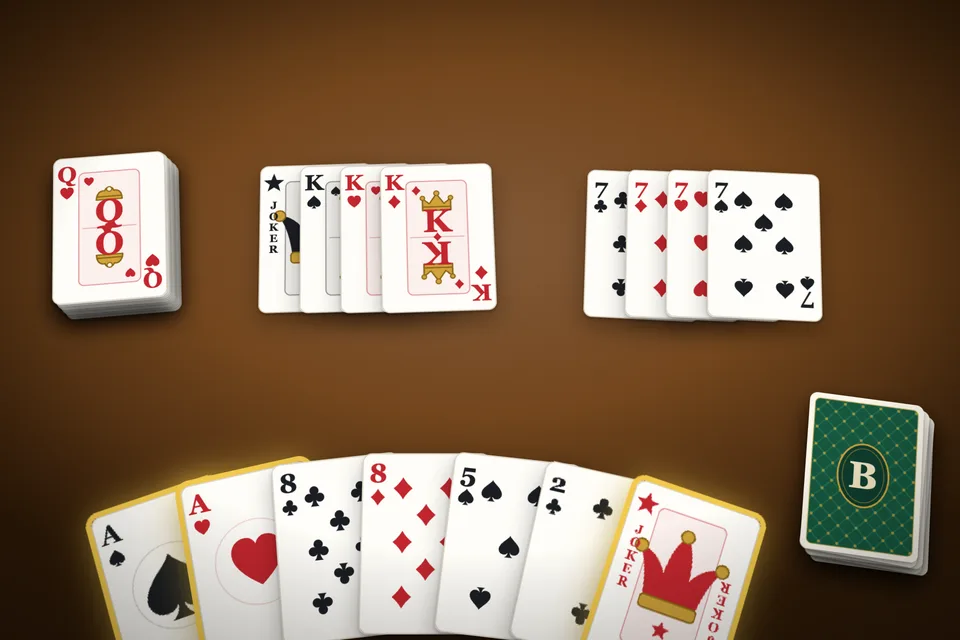
Play classic Klondike Solitaire online free in your browser, the same card game that came with Windows. Drag cards or just tap them, choose Draw 1 or Draw 3, and use unlimited undo and hints — every deal can be won, and there is a new daily deal each day.
How to play Solitaire
This is the quick guide to get you playing. For the complete rules, with worked examples, both scoring systems and the house rules that vary from table to table, read our complete Solitaire rules guide.
Klondike is the game most people simply call Solitaire — the one that came free with every Windows PC for decades. You play alone with a standard 52-card deck, and the goal is to move every card onto four foundation piles, one for each suit, built in order from Ace up to King.
The layout
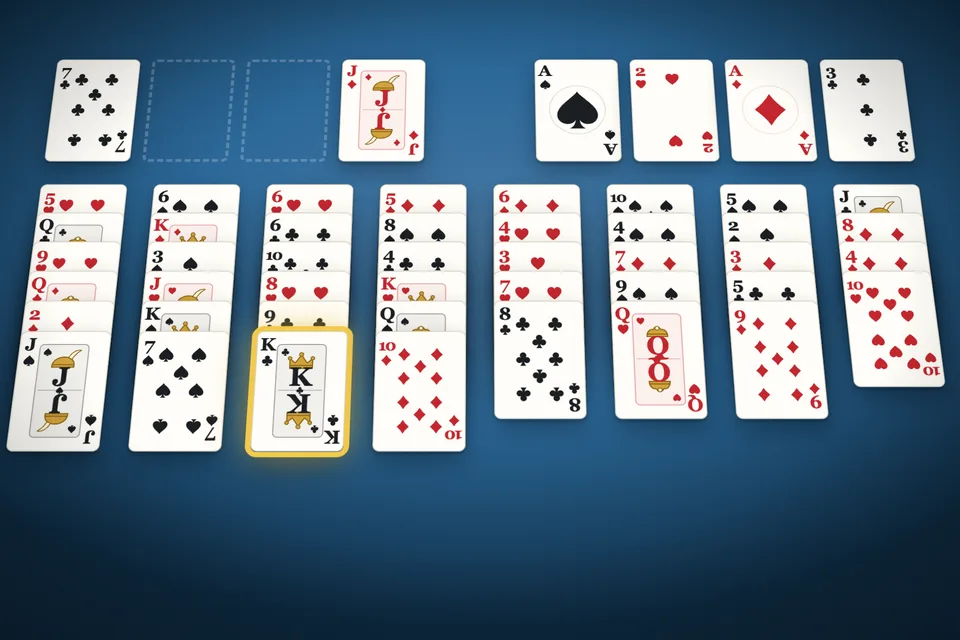
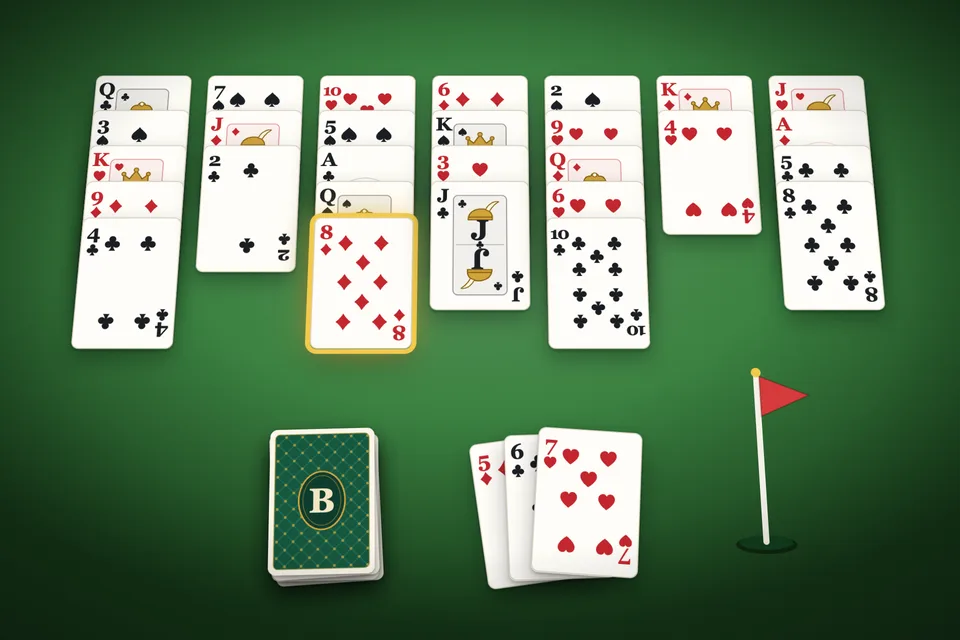
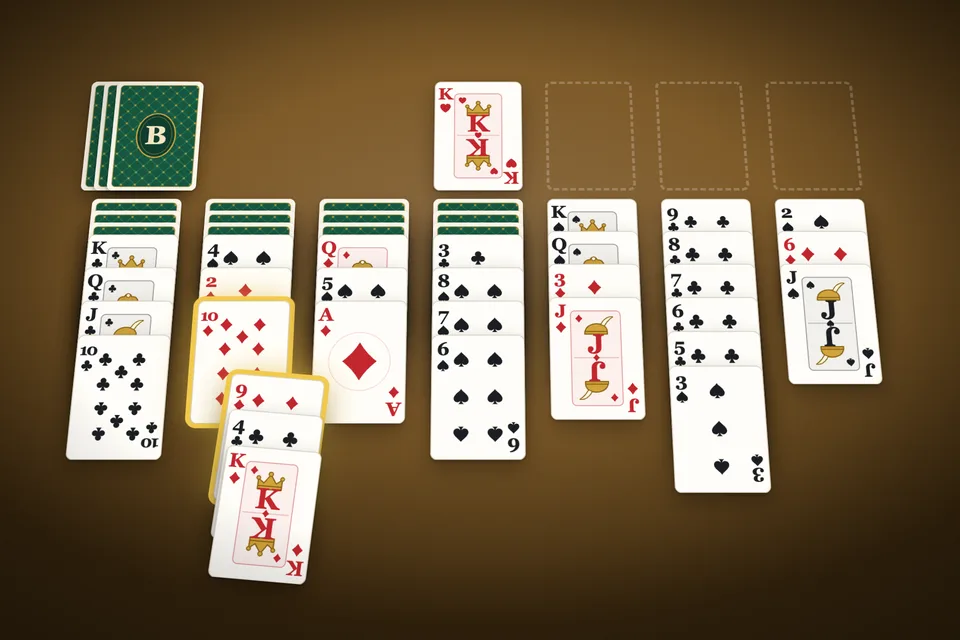
- The tableau is the row of seven columns across the middle. The first column holds one card, the second two, and so on up to seven. Only the bottom card of each column starts face up.
- The stock is the face-down pile in the top-left corner — the 24 cards that were not dealt to the tableau.
- The waste sits next to the stock. Cards you turn over from the stock land here, and only the top waste card can be played.
- The foundations are the four spaces at the top right. They start empty and are where you win the game.
Moving cards
- Build down in alternating colors on the tableau. A card can go on a face-up card one rank higher of the opposite color: a red 9 on a black 10, a black 4 on a red 5.
- Move stacks, not just single cards. Any correctly built run of face-up cards can be moved together, as long as its top card fits where it lands.
- Turn over hidden cards. When you move the last face-up card off a column, the face-down card underneath flips over automatically.
- Fill empty columns with Kings. Only a King — or a run that starts with a King — can be moved into an empty column.
- Build the foundations up by suit. Start each foundation with an Ace, then add the 2, 3 and so on of the same suit, up to the King.
- Use the stock when you are stuck. Tap the stock to turn over one card (Draw 1) or three cards (Draw 3). When the stock runs out, tap the empty space to turn the waste back over and go through it again.
Winning
You win when all 52 cards are on the foundations. Once every card is face up and the stock is empty, the rest is a formality — press Auto-finish and the cards fly home on their own.
Playing on BieGames
Drag a card or a whole stack to move it, or simply tap a card and it jumps to the best spot it can go — a foundation first, then a column. Prefer to pick the spot yourself? Switch Tapping a card to Selects it in Settings, then tap the glowing destination. On a keyboard, Tab and the arrow keys move between cards, Enter sends a card to its best spot, Space selects it, D draws from the stock, H shows a hint, and Ctrl+Z (⌘Z on a Mac) undoes.
Solitaire scoring
Choose a scoring style in Settings. Standard scoring follows the classic Windows rules:
| Move | Points |
|---|---|
| Waste card to the tableau | +5 |
| Any card to a foundation | +10 |
| Turning over a tableau card | +5 |
| Foundation card back to the tableau | −15 |
| Recycling the waste (Draw 1) | −100 |
| Recycling the waste (Draw 3, after the first three passes) | −20 |
Your score never drops below zero. When you win, a time bonus of 700,000 divided by your time in seconds is added (for games of 30 seconds or longer), so fast wins score big.
Vegas scoring treats the game like a casino bet: you pay $52 for the deck and earn $5 for every card you get onto a foundation. Draw 1 allows only one trip through the stock, and Draw 3 allows three, so every decision counts. Your running Vegas total carries over from game to game. Want a table set up for Vegas from the very first deal? Try Vegas Solitaire. Pick None if you would rather just play.
Solitaire strategy tips
- Uncover face-down cards first. Hidden cards are the real obstacle. When you have a choice, make the move that flips a card — especially in the columns with the most cards still face down.
- Look at the tableau before the stock. Play every useful tableau move before you turn over more stock cards; the card you need may already be on the table.
- Don't empty a column without a King to fill it. An empty column is only useful for a King. Clear one when a King is ready to move in, not before.
- Choose your King with care. If two Kings could take an empty column, pick the one that frees more hidden cards, or the one whose color matches the Queens you can reach.
- Don't rush cards to the foundations. Aces and twos can always go up, but a black 6 might be the only place for a red 5 you will need later. Send middle cards up when nothing still in play needs them.
- Keep your options open in Draw 3. Playing one waste card changes which cards you will see on the next pass. Sometimes it pays to hold back so a key card lines up.
- Work on the biggest columns. The seventh column hides six cards. Freeing it early opens up the game far more than clearing a short column.
- Use Undo to explore. Undo is unlimited here. If a line of play goes nowhere, step back and try another — it is how strong players learn.
- Ask for a hint when you are stuck. Hint cycles through every move that makes progress, so press it again to see the next idea.
Draw 1 vs. Draw 3 and other options
Draw 1
Turning over one card at a time means you can reach every card in the stock on every pass. It is the friendlier way to play and a great place to start: most Draw 1 deals can be won with careful play.
Draw 3
Turning over three cards at a time means only every third card is playable until something changes. It is the traditional rule and a much tougher puzzle, because you need to plan which waste cards to play so the cards you want come up next time.
Winnable deals
Not every shuffle of a deck can be won. With Winnable deals only turned on (the default), BieGames checks each deal with a solver before you see it and only gives you shuffles that can be solved — though you still have to find the way. Switch to Any deal for completely random shuffles, the way a real deck falls. Curious how often a random deal can be won? See Are all Solitaire games winnable?
The daily deal
Every day there is one daily deal, the same for everyone. It is always a winnable deal. Win it to build your daily streak, and come back tomorrow for a new one.
Other solitaire games
When you're ready for a change, FreeCell deals every card face up so you can plan the whole game, and Spider Solitaire uses two decks and ten columns for a longer puzzle.
A short history of Klondike
Patience games — the British name for solitaire — became popular in Europe in the 1800s. Klondike takes its name from the Klondike region of Canada's Yukon, home of the gold rush of the late 1890s, and the game was spread by prospectors and travelers. It was described in card game books by the early 1900s and soon became the best-known solitaire in North America.
Its biggest boost came in 1990, when Microsoft included Solitaire with Windows 3.0. The game was there partly to teach people how to use a mouse — dragging and dropping cards was the perfect practice — and its bouncing-card victory animation became one of the most recognizable sights in computing. Today Klondike is still one of the most played games in the world.
Want every detail, with examples and the common house rules? Read our complete Solitaire rules guide.
Solitaire FAQ
Is Solitaire the same as Klondike?
Yes. In the United States, "Solitaire" almost always means Klondike, the game with seven columns, a stock pile and four foundations. Other solitaire games such as FreeCell and Spider use different layouts and rules.
What is the difference between Draw 1 and Draw 3?
In Draw 1 you turn over one card from the stock at a time, so you can reach every card on every pass. In Draw 3 you turn over three at a time and can only play the top one, which makes the game much harder. Choose either one in Settings.
Can every game of Solitaire be won?
No — some shuffles cannot be solved no matter how you play. That is why BieGames offers Winnable deals only, which uses a solver to make sure every deal you get has a solution. The daily deal is always winnable too.
How many times can I go through the stock?
As many times as you like with Standard scoring or no scoring. With Vegas scoring you get one pass in Draw 1 and three passes in Draw 3.
Can you move part of a pile in Solitaire?
Yes. You can pick up a run from any face-up card, and the cards lying on top of it come along, as long as the first card fits where it lands. From 10♠ 9♥ 8♣ 7♦, for example, you can move just the 8♣ 7♦ onto a red 9. Face-down cards never move; they wait until they are uncovered.
Why do colors have to alternate in Solitaire?
It is simply the rule of Klondike, and it is what makes the game a puzzle. A red 9 can only go on one of the two black 10s, so you have to plan where each card will land. Other solitaire games build differently: Spider builds down in any suit, and Baker’s Game, the ancestor of FreeCell, builds down in the same suit.
How many cards are dealt in Solitaire?
Twenty-eight cards go to the seven tableau columns — one in the first column, two in the second and so on up to seven — and only the top card of each column starts face up. The other 24 cards form the stock.
Can I put any card in an empty column?
No. In Klondike only a King, or a stack that starts with a King, can be moved into an empty column.
Can I take a card back off a foundation?
Yes. You can drag the top card of a foundation back onto the tableau if it fits there. With Standard scoring it costs 15 points, but it can rescue a stuck game.
Is there an undo button?
Yes, and undo is unlimited — step back as many moves as you like with the Undo button or Ctrl+Z (⌘Z on a Mac). The Hint button suggests useful moves when you are stuck.
Can I play Solitaire on my phone?
Yes. BieGames Solitaire works in any modern browser on phones, tablets and computers with nothing to download. Tap or drag cards, and your game is saved automatically so you can pick it up later.
What is the best first move in Solitaire?
Play any Aces and Twos to the foundations, then look for a move that turns over a face-down card — ideally in the right-hand columns, which hide the most cards. Make every useful tableau move before you start turning over the stock.
Is Solitaire a game of skill or luck?
Both. The shuffle decides whether a deal can be won at all, and roughly one Klondike deal in five or six cannot be won even with perfect play. But good choices — which column to work on, which card to move, when to use the stock — win many games that careless play would lose.
What is Vegas Solitaire?
Vegas is a scoring style that treats the game like a casino bet. You pay $52 for the deck and earn $5 for every card you get onto a foundation, so you need 11 cards just to come out ahead. Draw 1 allows one pass through the stock and Draw 3 allows three. Choose Vegas under Scoring in Settings, or play Vegas Solitaire.