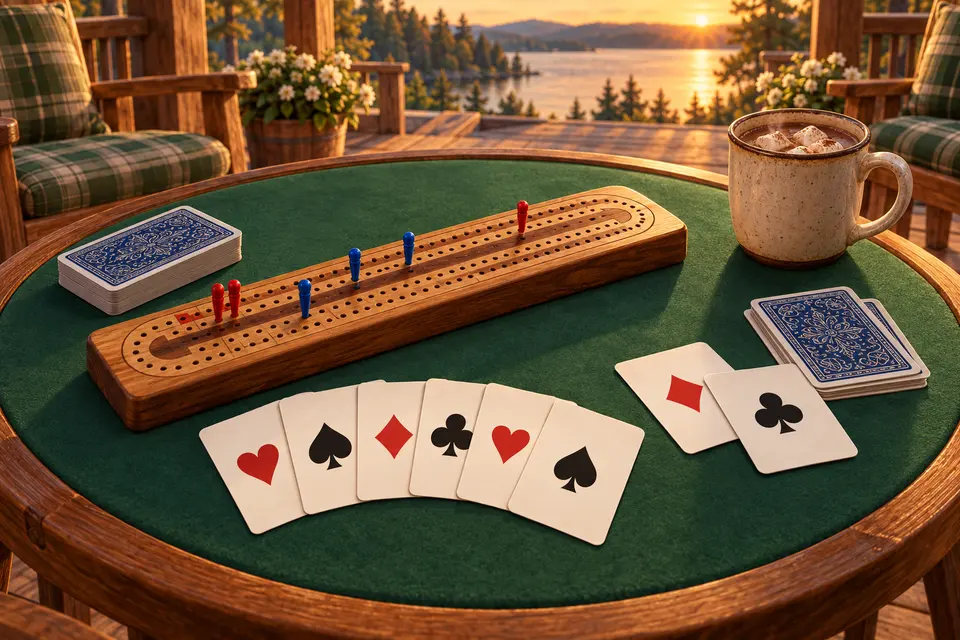
Every hand of Cribbage starts with the same small puzzle: you’re dealt six cards, and two of them have to go in the crib. There are 15 different ways to split six cards into four and two, and choosing well is one of the most important skills in the game.
The trick is that the right answer depends on whose crib it is. This guide explains how to think about the discard from each seat, which cards to keep and which to let go, and walks through real hands where the same six cards call for different throws.
The one question to ask
The crib always belongs to the dealer. So before you choose, ask yourself: is this my crib or my opponent’s?
- When you’re the dealer, you score your hand and the crib. The two cards you throw are still working for you, so you want your four kept cards and your two thrown cards to be as strong as possible together.
- When you’re the pone (the non-dealer), you score your hand, and every point in the crib goes to your opponent. You want a good hand and a dull crib.
That’s the whole idea. Everything else is detail.
Start with your own hand
Whatever your seat, your four kept cards come first. Count what each possible keep is worth on its own, then think about the starter: the card cut after the discard, which counts as a fifth card in every hand.
Some keeps are fine as they are but can’t get much better. Others are worth a little now and a lot after a good cut. As a rule, prefer cards that work with many starters:
- 5s. There are sixteen ten-value cards in the deck — every 10, Jack, Queen and King — and a 5 makes fifteen with any of them. That’s nearly a third of the deck.
- Cards that touch in rank, like 6-7-8. A run of three can become a run of four, or a double run if the starter pairs one of its cards.
- Pairs. A pair is 2 points now, and if the starter matches it you have three of a kind for 6.
- Cards that add up to 5, like 2-3 or A-4. They make fifteen with any ten-value card, just like a 5.
High cards that don’t connect — a lone King, a 9 next to a Queen — rarely improve. They’re the first candidates for the crib.
If you want to check a count while you’re learning, our cribbage hand calculator will add up any hand for you. For the counting rules themselves, see how to count a cribbage hand.
When it’s your crib
As the dealer, the crib is a bonus hand. Throw it cards that help each other:
- A 5, or better yet a pair of 5s, if your hand doesn’t need them.
- A 5 with a ten-value card, which is already a fifteen.
- Fifteens: 7-8 or 6-9.
- A pair, or cards that touch in rank, like 7-8 or 2-3.
- 2-3 or A-4, which make fifteen with any ten-value card.
When two choices score about the same in your hand, give the better cards to your crib. But don’t break up a strong hand to feed it: the points in your hand are much more certain than the crib’s, since two of the crib’s cards come from your opponent.
When it’s your opponent’s crib
As the pone, you’re trying to give the crib as little as possible. Good throws, sometimes called balking cards, have nothing to do with each other:
- Far apart in rank. The classic safe throw is a King with a card well below it, like K-10, K-9, K-8 or K-7, or a Queen with a 9, 8 or 7. A King can only sit at the top of a run, so it needs both a Queen and a Jack to score one. That makes it the safest card to give away.
- No 5s. A 5 is the best card in Cribbage to receive. If you must throw one, you’re probably holding something worth even more.
- No pairs, no fifteens, no touching cards. 7-8, 6-9 and 5-10 are fifteens already; 7-8 is also two-thirds of a run.
- Not 2-3 or A-4. They look harmless, but any ten-value card turns them into a fifteen.
These are rules of thumb, and your own hand still comes first. If the safest throw would break up points in your hand, a slightly riskier one can be the better choice, as the first example below shows.
Suits matter much less. A crib only scores a flush when all four crib cards and the starter are the same suit, so throwing two cards of the same suit rarely adds anything.
Worked examples
Each example shows the six cards dealt, then a strong throw from each seat. “Before the cut” means the points your four cards are already worth.
1. Same cards, different throws
Dealt: 2♦ 3♣ 7♠ 8♥ Q♠ K♣
As dealer: keep 2♦ 3♣ Q♠ K♣, throw 7♠ 8♥ to your crib. Your hand has 2 + 3 + Q and 2 + 3 + K — 4 points before the cut — and your crib starts with a fifteen.
As pone: keep 2♦ 3♣ 7♠ 8♥, throw Q♠ K♣. Your hand has only 7 + 8, 2 points before the cut, but 2-3 still makes fifteen with any ten-value starter. And instead of a ready-made fifteen, your opponent’s crib gets a Queen and a King.
The pone’s throw is a close call. Queen and King are touching cards, so a Jack in the crib would make them a run. Throwing the King with the 7 or 8 would be a slightly safer gift, but it breaks up the 7-8 fifteen, and that costs your hand a little more than it saves in the crib.
This is the heart of discard strategy. The dealer’s best play gives away 7-8 because the points stay home. The pone keeps 7-8 because handing it over would cost more than the hand gains.
2. Don’t break up a big hand
Dealt: 4♣ 5♦ 6♥ 6♠ 10♣ Q♦
Either seat: keep 4♣ 5♦ 6♥ 6♠, throw 10♣ Q♦.
“Fifteen two, fifteen four” (4-5-6 with each 6), “a pair is six, and a double run is twelve.” That’s 12 points before the cut, and many starters add more.
As dealer you might be tempted to put the 5 in your crib with the 10. Don’t: the double run is worth far more in your hand. As pone, 10-Q is a fine throw: it could join a Jack for a run, but there’s no fifteen and no 5.
3. Keep the 5s when they make your hand
Dealt: 5♣ 5♥ K♦ Q♠ 9♣ 2♥
Either seat: keep 5♣ 5♥ Q♠ K♦, throw 9♣ 2♥.
Each 5 makes fifteen with the Queen and with the King — fifteen two, four, six, eight — and the pair makes 10 points before the cut.
“Never throw a 5 into your opponent’s crib” has a twin: “keep your 5s when they’re doing the work.” Even as dealer, splitting these fives would trade a sure 10 for a hopeful crib.
4. A flush isn’t always worth keeping
Dealt: A♥ 4♥ 7♥ 10♥ 5♠ J♣
As dealer: keep the flush, A♥ 4♥ 7♥ 10♥, and throw 5♠ J♣ to your crib. The hand has a four-card flush for 4 and A + 4 + 10 for 2 — 6 points before the cut — and your crib starts with a fifteen.
As pone: keep A♥ 4♥ 5♠ J♣, throw 7♥ 10♥. The hand has 5 + J and A + 4 + J, 4 points before the cut.
As pone, keeping the flush would mean handing your opponent a 5 and a Jack — one of the best two-card gifts in the game. Breaking the flush costs 2 points in your hand and saves more than that in their crib.
5. Breaking a tie
Dealt: 5♥ 6♣ 7♦ 9♠ J♣ K♥ — you’re the pone.
Keeping 5-6-7-9 (6 + 9, and a run) or 5-6-7-J (5 + J, and a run) is worth 5 points either way. Keep 5-6-7-J and throw 9♠ K♥.
Two reasons. A Jack and King in the crib can join a Queen to make a run, while a 9 and King are too far apart. And keeping the Jack gives you a chance at his nobs if the starter turns up a club.
Think about the pegging, too
The discard also decides which cards you’ll have for the play. When two keeps are close in value:
- Keep a low card. A card under 5 is a safe lead, since your opponent can’t make fifteen with one card. Low cards also squeeze in near 31.
- Keep a pair if you can. If your opponent pairs your lead, you can answer with three of a kind for 6.
- Remember who leads. The pone always plays first, so the pone in particular wants a safe lead in hand.
Near the end of the game
As the finish line gets close, think about the board rather than the average hand. The pone counts first in the show, then the dealer counts their hand and the crib. If a sure 8 points in your hand will carry you home, keep it, even if another discard looks better on average. And if you’re far behind, take the riskier keep that could score big.
Rules of thumb
| Situation | Throw | Avoid throwing |
|---|---|---|
| Your crib | 5s, pairs, fifteens (7-8, 6-9, 5 with a ten), touching cards, 2-3 or A-4 | Nothing in particular — but keep your hand strong first |
| Opponent’s crib | A King or Queen with a card well below it (K-10, K-9, Q-8) | 5s, pairs, fifteens, touching cards, 2-3 and A-4 |
Practice the discard
The fastest way to get a feel for discards is to play a lot of hands. You can play Cribbage free against June on BieGames, at Easy, Normal or Hard. Before you send your two cards, press Hint to see which throw the computer would choose — it weighs every possible starter — and compare it with your own pick. For the full rules, from the deal to pegging out at 121, see our Cribbage rules guide.
Play Cribbage free
Every game on BieGames runs right in your browser — no download, no sign-up, friendly computer players.