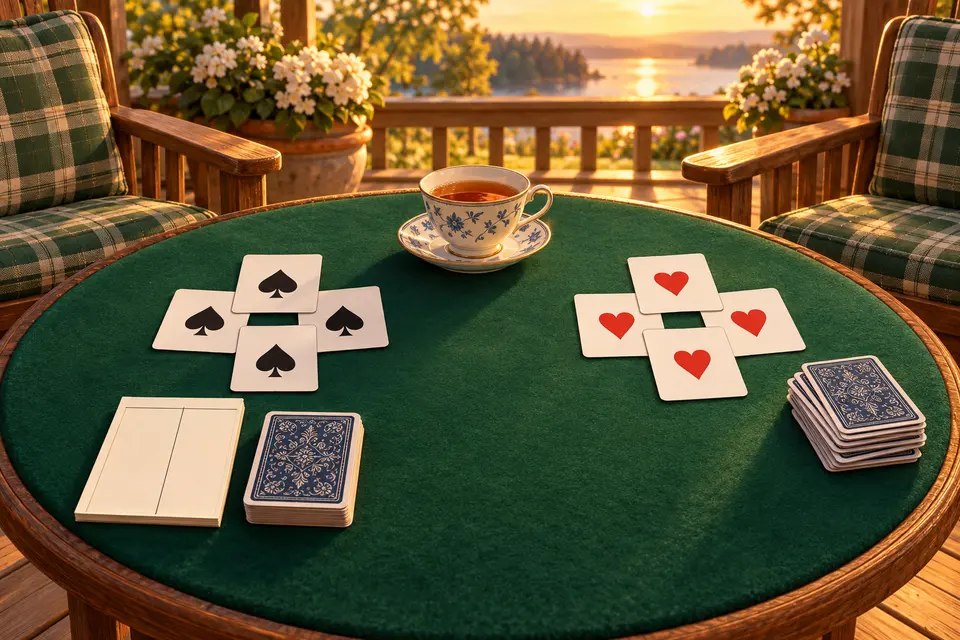
Spades and Hearts look like twins. Both use a standard 52-card deck, deal 13 cards to each of four players, and play out 13 tricks where you must follow suit if you can. Sit down at either table and the first few tricks feel almost identical.
Then the scores come in, and you realize they are opposites. In Spades you fight to win the exact number of tricks you promised. In Hearts you fight not to win the wrong cards. Here is how the two games really differ, and how to pick the one that fits your mood.
The quick comparison
| Spades | Hearts | |
|---|---|---|
| Teams | Two partnerships of two | Every player for themselves |
| Trump | Spades are always trump | No trump suit at all |
| Bidding | Yes — each player bids tricks | No bidding; you pass three cards |
| Goal each hand | Make your team’s contract | Avoid hearts and the Queen of Spades |
| Scoring | Points are good; first to 500 wins | Points are bad; lowest score wins |
| Big gamble | Bidding Nil (zero tricks) | Shooting the moon (all the penalty cards) |
| Feels like | A team sport | A polite knife fight |
Partners or every player for themselves
The biggest difference isn’t on the cards at all: it’s who sits on your side.
Spades is a partnership game. You and the player across from you combine your bids into one team contract and share one score. Half the skill is reading your partner — if they lead a low club, are they hoping you can win it, or trying to get rid of their clubs? A good Spades partnership wins far more often than two strong players who ignore each other.
Hearts has no partners. Each of the four players keeps their own score, and alliances shift trick by trick. The player who was helping you dump the Queen of Spades on the leader five minutes ago will happily dump it on you when you pull ahead. If you enjoy a little table politics, Hearts is the one.
Trump: always spades, or nothing at all
In Spades, spades are always trump. When you can’t follow the suit that was led, you may play a spade, and the highest spade wins the trick. Spades can’t be led until one has been played on another suit (they are “broken”), unless you have nothing else.
Hearts has no trump. The highest card of the suit led always wins, no matter what else is played. Running out of a suit in Hearts doesn’t let you take tricks — it lets you throw away dangerous cards, like a high heart or the Queen of Spades, on someone else’s trick.
That one change turns the same mechanics inside out. In Spades a void suit is a weapon for winning tricks. In Hearts it’s an escape hatch.
Bidding vs. passing
Each Spades hand starts with bidding. Every player says how many tricks they expect to win, from 1 to 13, or bids Nil — a promise to win none. Your bid plus your partner’s is your team’s contract. Bidding well is the heart of the game: bid too low and you collect penalty “bags,” bid too high and you’re set.
Hearts has no bidding. Instead, before most hands each player passes three cards to another player — left, then right, then across, then a hold hand with no passing. Passing is where a lot of Hearts strategy lives: you can pass away your high spades to protect yourself from the Queen, or empty a short suit so you can start discarding early.
Scoring: chasing points vs. avoiding them
Spades rewards accuracy. A team that makes its contract scores 10 points per trick bid, plus 1 point for each extra trick. But those extra tricks are bags, and every 10 bags costs 100 points. A team that misses its contract loses 10 points per trick bid. The first team to 500 points wins (many people play to 250 or 300 for a shorter game).
Hearts is a penalty game. Every heart you take costs 1 point, and the Queen of Spades costs 13 — 26 penalty points per hand in all. When someone reaches 100, the game ends and the lowest score wins.
In Spades you watch your own score climb. In Hearts you watch everyone else’s, hoping someone else crosses 100 first.
The big gambles: Nil and shooting the moon
Both games have a dramatic all-or-nothing play.
In Spades, you can bid Nil — zero tricks. Make it and your team gets 100 points on top of your partner’s contract; take even one trick and you lose 100. Your partner’s job becomes protecting you by winning any trick you might be stuck with.
In Hearts, you can shoot the moon by taking every heart and the Queen of Spades. Pull it off and, instead of taking 26 points, you give 26 to each of your opponents (or subtract 26 from your own score). It’s the one moment in Hearts when you want the cards everyone else is running from — and the other three players will team up to stop you.
Which one should you play?
Choose Spades if you…
- like playing on a team and reading a partner’s signals,
- enjoy planning a whole hand up front with a bid,
- want a game where winning tricks feels good.
Choose Hearts if you…
- would rather rely only on yourself,
- like defensive, cat-and-mouse play,
- enjoy the drama of a late shoot-the-moon attempt.
If you’re completely new to trick-taking games, Hearts is a slightly easier start: there’s no bidding, and the main rule — don’t take hearts or the Queen of Spades — is easy to keep in your head. Once you’re comfortable following suit and counting cards, Spades adds bidding and partnership play on top.
Try both
The best way to feel the difference is to play a few hands of each. On BieGames you can play Spades with a computer partner against two computer opponents, or Hearts against three computer players — free, in your browser, with Easy, Normal and Hard levels. Each game page explains the full rules right under the table, and the hint button will suggest a play while you learn. Only two of you at the table? Spades has a two-handed version too — see how to play Spades with 2 players.
Play these games free
Every game on BieGames runs right in your browser — no download, no sign-up, friendly computer players.