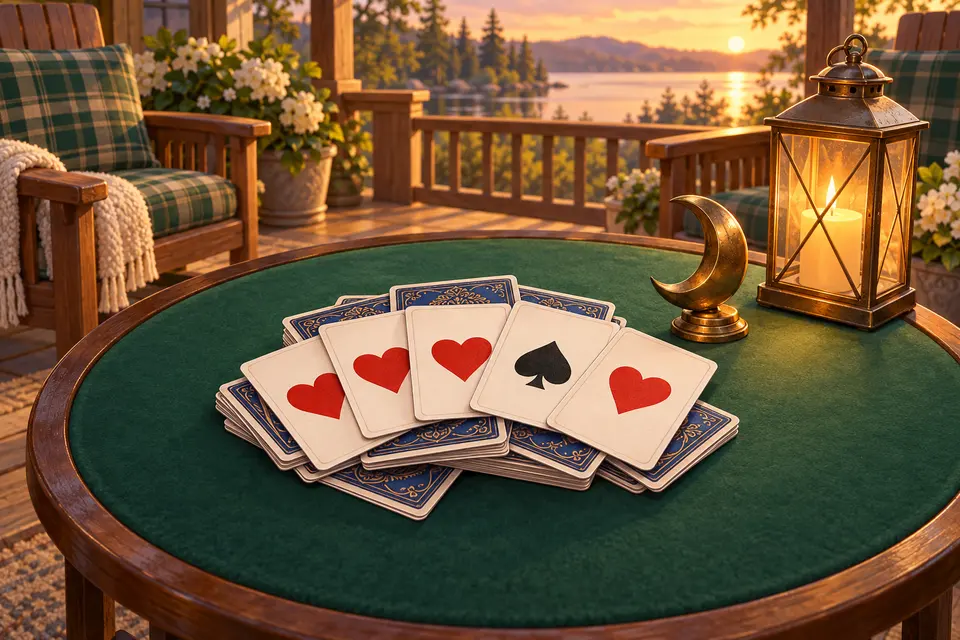
Every game of Hearts has the same rhythm: duck the hearts, dodge the Queen of Spades, and hope the points land on someone else. Then, every so often, one player stops ducking. They start winning trick after trick, collecting hearts as if they wanted them — and three players suddenly realize what’s happening.
That’s shooting the moon, the biggest swing in Hearts. Here’s how to recognize a hand that can do it, how to play it, and how to stop someone else before it’s too late.
What shooting the moon means
Each heart you take costs 1 point and the Queen of Spades costs 13, for 26 points in every hand. If one player takes all 13 hearts and the Queen of Spades, they’ve shot the moon. Instead of taking 26 points:
- in the most common version, the shooter scores 0 and every other player takes 26;
- in the other popular version, the shooter subtracts 26 from their own score and nobody else changes.
The catch is that it’s all or nothing. If you collect 25 points and someone else grabs a single heart, you keep all 25. A failed moon is the worst hand you can have, which is why the decision matters so much. (The Hearts rules guide covers the scoring in full.)
What a moon hand looks like
Most moon shots aren’t planned from the deal. They grow out of hands that have three things:
- Long, high hearts. The Ace, King and Queen of hearts, plus some length. Your hearts have to win tricks, not sneak under them.
- Control of the other suits. Aces and Kings in your side suits let you win the lead back whenever you lose it.
- A way to catch the Queen of Spades. Either you hold her, or you hold the Ace or King of spades and can capture her when she’s played.
What ruins a moon hand is low cards you can’t get rid of — a lone 3 of diamonds, say. Sooner or later you’ll have to play it, an opponent will win that trick, and if anyone throws a heart on it, your moon is over.
A real moon candidate. You hold ♥ A K Q J 9 6 · ♠ A K 4 · ♣ A K · ♦ A 3. Six strong hearts, top cards in every other suit, and the A♠ K♠ to trap the Queen. The weak spots are the 4♠ and the 3♦: when you play them, someone else wins the trick, and if a heart or the Queen lands on it, the moon is over. The plan: win early tricks with your side-suit Aces and Kings, catch the Q♠ with the A♠ or K♠, and lead your hearts from the top. Play the low cards either early, while everyone can still follow suit and has no reason to discard a heart, or at the very end, after you’ve drawn every heart still out.
Passing for the moon
Passing is where many moons are born. If your hand is leaning that way:
- Keep your high hearts instead of passing them away.
- Pass your lowest cards, especially small cards in short suits that could lose the lead at the wrong moment.
- Don’t pass the Ace or King of spades — you need them to catch the Queen.
Be honest with yourself here. Passing away your low cards to chase a moon leaves you with a hand full of high cards, which is a terrible hand if the moon doesn’t come off.
How to play a moon hand
Stay quiet early
The other players can stop you only if they notice. In the early tricks, win with your side-suit Aces and Kings the way anyone might. Taking a trick or two with no points in it doesn’t look suspicious.
Catch the Queen
The Q♠ is often the turning point. If you hold her, you’ll eventually need to win a trick with her in it — lead her yourself late, when nobody holds a higher spade, or simply win the trick she lands on. If someone else holds her, leading the A♠ or K♠ invites them to dump her on your trick, which is exactly what a moon shooter wants.
Draw the hearts from the top
Once hearts are broken, lead your highest hearts first: A♥, then K♥, then Q♥. Each lead pulls out other players’ hearts while you still hold the higher ones. Leading a low heart too early is the classic mistake — someone with a middle heart wins the trick and the moon is gone.
Know when to bail out
If an opponent wins a single heart, the moon is over. Switch gears immediately: stop collecting, start ducking, and try to give the remaining hearts and the Queen to someone else. The sooner you give up a doomed moon, the fewer points you eat.
The late moon
Some of the best moons are never planned. Halfway through a hand you notice that you’ve taken the Queen and every heart played so far — and the cards you have left are mostly winners. Count what’s still out. If you hold the highest remaining heart in every round you’ll need to play, and you can keep winning the lead, go for it. A surprise late moon is hard to stop because nobody saw it coming.
How to stop a moon shot
Stopping a moon is simple in theory: one heart in your tricks (or in anyone’s tricks besides the shooter’s) ends it. Doing it in practice takes attention.
Watch who’s taking the points
After every trick, notice who won it and what was in it. Warning signs:
- One player has taken the Q♠ and every heart so far.
- That player keeps leading high cards and winning.
- They didn’t seem to mind taking points they could have avoided.
Once you see two or three of these, assume a moon is on.
Keep a stopper
The best defense is a heart the shooter can’t beat — or at least one that can win a trick. If you suspect a moon, hang on to a middle or high heart (a 10♥ or J♥, for example) instead of throwing it away. When hearts are led, or when you can lead one yourself, you may win that trick and break the moon for the price of a point or two.
A stop in action. Eight tricks in, Rose has taken the Q♠ and seven hearts, including the A♥. She leads the K♥. You hold the J♥ and the 5♥. Your instinct might be to throw the J♥ under her King just to be rid of it. Don’t. Play the 5♥ and keep the J♥: once Rose’s top hearts run out, it may be the highest heart left. When she leads her next heart — or when you get the lead — the J♥ wins a trick with a heart in it. It costs you a couple of points; it saves you 26.
Don’t feed the shooter
When you can’t follow suit, you’d normally throw a heart away. Against a suspected moon, throw your hearts onto tricks another opponent is winning instead. A single heart landing on Hank’s trick ends Rose’s moon just as well as one landing on yours.
Don’t block too early
Taking hearts on purpose costs you points. If you block on every hand where someone takes a few early hearts, you’ll give away more than you save. Wait until the signs are clear — but not so long that the shooter holds every remaining winner.
Should you go for it?
A moon is worth chasing when the hand truly supports it, or when the score makes it worth the risk. If you’re far behind late in the game, a successful moon can swing the standings by 26 points against every opponent at once. If you’re comfortably in the lead, a failed moon could hand the game away — play the hand safely instead.
One more thing to check before the last trick: under the “everyone else gets 26” scoring, a moon that pushes another player past 100 ends the game. That’s great if you have the lowest score, and a disaster if you don’t. Some tables let the shooter choose the scoring for exactly this reason.
Practice your moon shots
The best way to learn which hands can shoot the moon is to try it a few times — and to watch the computer try it on you. On BieGames you can play Hearts free against three computer players; on Normal and Hard they watch for moon shots, and Hard players will attempt one when the cards allow. Settings let you choose either moon scoring rule. If you enjoy the trick-taking but want a partner on your side, see how Hearts compares in Spades vs Hearts.
Play Hearts free
Every game on BieGames runs right in your browser — no download, no sign-up, friendly computer players.