Gin Rummy is a game for two. Everything about it — the ten-card hands, the knock, the undercut — is built around one player’s deadwood against another’s. So what do you do when a third or fourth person pulls up a chair?
You have two good options. You can keep Gin a two-player game and organize the table around it, which is exactly how the traditional three- and four-player versions work. Or you can switch to a rummy game designed for a crowd. This guide covers both.
Why Gin stays head to head
At the end of every Gin hand, the knocker’s deadwood is compared with one opponent’s. The defender lays off on the knocker’s melds, the difference is scored, and an undercut happens when the defender’s count is equal or lower. None of that works neatly with three hands on the table.
There’s also the deck. Two players take 20 cards, and the rest makes a stock long enough for a real game. Deal ten cards each to four players and, after the up-card, just 11 cards would be left for the stock.
So rather than changing Gin, the multi-player versions change who plays whom.
Gin Rummy for 3 players
The traditional three-handed game, as described on Pagat, keeps every hand a two-player game:
- The dealer sits out. They deal ten cards to each of the other two players, who play a normal hand of Gin.
- The loser deals next. When the hand ends, the player who lost it becomes the next dealer and sits out. The next hand is played between the winner and the player who just dealt.
- Everyone keeps their own score. Each player has a column on the score sheet and plays toward the target alone.
It’s a “winner stays on” format: keep winning and you keep playing, lose and you take a turn with the deck. While you’re sitting out, you can watch the discards — a nice way to learn how other players read the game.
Scoring a three-handed game
Score every hand exactly as in two-player Gin:
| Result | Points to the winner of the hand |
|---|---|
| Knock | The opponent’s deadwood minus the knocker’s |
| Undercut (defender ties or beats the knocker) | The difference plus the undercut bonus |
| Gin | The opponent’s deadwood plus the gin bonus |
The common bonuses today are 25 for gin and 25 for an undercut; older rule books use 20 and 10. Decide on a target before you start — 100 is the usual game — and agree beforehand how the end-of-game bonuses work with three. One simple way is to give the 100-point game bonus to whoever reaches the target first, and a box (line) bonus for every hand each player won.
A round-robin alternative
If you’d rather everyone played the same number of hands, play short two-player matches in rotation: A against B, then B against C, then C against A, with the third player sitting out each time. Keep one running score for each player.
Gin Rummy for 4 players (partnership gin)
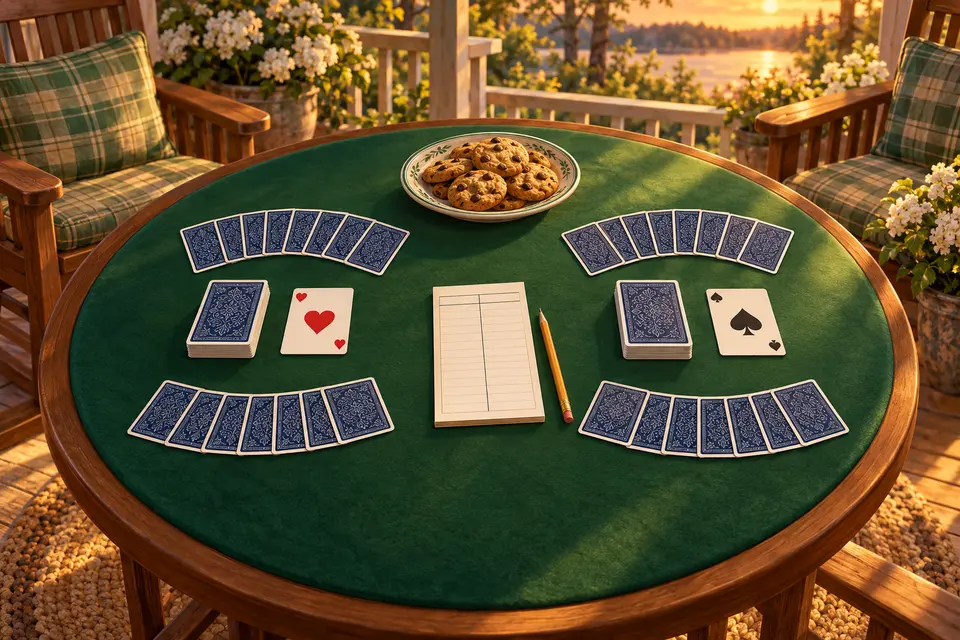
Four players can play as two partnerships, which turns Gin into a team game without changing how a single hand works:
- Pair up. Split into two teams of two.
- Play two games at once. Each player plays an ordinary hand of two-player Gin against one member of the other team. That’s two separate deals, each with its own stock and discard pile.
- Combine the results. When both hands are over, put the results together for the team:
- If both players on a team won their hands, the team scores the total of their points.
- If one player from each team won, the team that won more points scores the difference.
- Switch opponents. For the next deal, players swap opponents but stay on the same teams.
Pagat’s rules play partnership gin to 125 points: the first team to reach it wins.
An example deal
You and Rose are partners against Hank and June.
You knock against Hank and score 14. At the other table, June goes gin against Rose and scores 31.
One player from each team won, so compare: Hank and June won 31, you and Rose won 14. Hank and June score the difference, 17 points.
Next deal, you play June and Rose plays Hank.
Keeping score
A simple score sheet has one column per team and a line for every deal. Here’s how the example game might continue, with 25-point gin and undercut bonuses:
| Deal | What happened | You & Rose | Hank & June |
|---|---|---|---|
| 1 | You win 14, June wins 31 | 0 | 17 |
| 2 | You knock against June and win 12; Rose undercuts Hank by 3 and wins 28 | 40 | 17 |
| 3 | You win 9 against Hank; June wins 21 against Rose | 40 | 29 |
In deal 2 both members of your team won, so you add their points together: 12 + 28 = 40. In deal 3 the teams split again, so Hank and June take the difference of 12. Keep going until one team reaches 125.
You’ll need two decks for partnership gin, one for each game, since both hands are played at the same time.
Why partnership gin is fun
Every hand matters twice. A small knock that would feel unremarkable on its own might be exactly what your team needs to cancel out your partner’s loss, and a big gin can carry a partner through a rough hand. It’s a social way to play: one table finishes and turns to watch the other.
Tips for multi-player Gin
- Play your own hand first. In partnership gin, your partner’s game is separate. Don’t let a big score at the other table make you careless — or desperate.
- Mind the clock in three-handed gin. The player sitting out is waiting. Knocking early with a low count keeps hands short and the game moving.
- Watch for undercuts late in a hand. The same advice as two-player Gin applies: the longer a hand goes, the lower your opponent’s deadwood gets, so knocking with 9 or 10 late in the stock invites an undercut.
- Agree on the house rules first. Gin and undercut bonuses, the target score and the end-of-game bonuses vary a lot from table to table. Settle them before the first deal.
For the full two-player rules — melds, deadwood, knocking, laying off and every bonus — see our Gin Rummy rules guide.
Quick questions
Can three people play one hand of Gin together? Not in the standard game. Knocking, laying off and undercuts all compare two hands, so the three-player version has one player sit out each hand instead.
Do partners help each other during the hand? No. Each game is played on its own, with no passing cards and no table talk about your hands. Partners only combine their scores.
How many cards does each player get? Ten, in every version here — just as in the two-player game.
Can five or more play? Not with these formats. For a bigger group, run separate games of Gin side by side, or choose a rummy game made for more players.
Or play a rummy game built for a crowd
If everyone wants to be in every hand, Rummy 500 is the natural choice. It’s played by two to four players from one deck: seven cards each with three or four players, melds laid face up on the table, an open discard pile you can dig into, and lay-offs on anyone’s melds. Every player scores every hand, so nobody sits out. Our Gin Rummy vs Rummy 500 guide compares the two in detail, and the Rummy 500 rules explain the scoring.
Play online
Short of a fourth player tonight? On BieGames you can play Gin Rummy free against Hank, a friendly computer opponent, with Easy, Normal and Hard levels and Oklahoma gin in Settings. Or play Rummy 500 with one, two or three computer players, so you can try the three- and four-player game any time.
Play these games free
Every game on BieGames runs right in your browser — no download, no sign-up, friendly computer players.