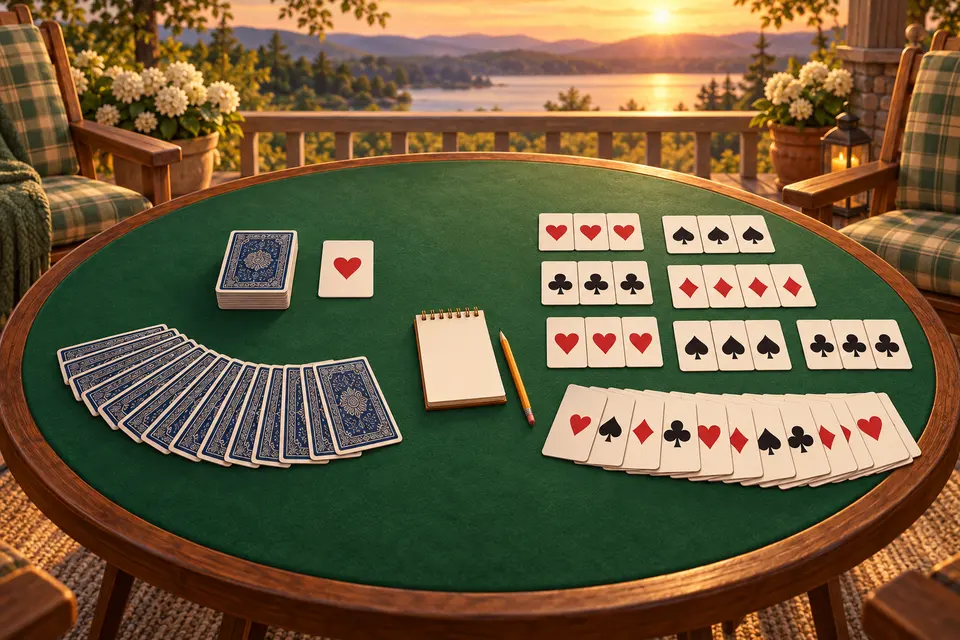
Gin Rummy and Rummy 500 come from the same family. In both you draw a card, discard a card and try to build sets (three or four of a kind) and runs (three or more in a row in one suit). If you know one, you can follow the other within a hand or two.
But they reward very different instincts. Gin is a tight, quiet duel where your melds stay hidden until someone knocks. Rummy 500 is an open, chatty table game where everything goes face up and the discard pile is a treasure chest. Here’s how the two really differ, and how to choose.
The quick comparison
| Feature | Gin Rummy | Rummy 500 |
|---|---|---|
| Players | 2 | 2 to 4 |
| Cards dealt | 10 each | 13 each with 2 players, 7 each with 3 or 4 |
| Melds | Kept in your hand until the hand ends | Laid face up on the table during play |
| Discard pile | Only the top card can be taken | Spread out; you can dig deep into it |
| Laying off | Only the defender, only after a knock | Anyone, on any meld, any turn |
| What scores | The gap between the two players’ deadwood | The cards you meld, minus the cards left in hand |
| Ace | Always low, 1 point | High or low; 15 points (1 in A-2-3) |
| Game | First to 100, plus bonuses | First to 500 |
| Feels like | Chess with cards | A friendly treasure hunt |
Hidden melds vs. melds on the table
This is the biggest difference, and almost everything else follows from it.
In Gin Rummy, you never lay melds down during play. You quietly arrange your ten cards in your hand, and your opponent only sees what you’ve picked up from the discard pile and what you’ve thrown away. The tension comes from not knowing how close the other player is.
In Rummy 500, you lay down sets and runs as soon as you make them, and they stay on the table for everyone to see. That’s not just for show: those cards are your score. It also means everyone knows what everyone else is building, and anyone can add to anyone’s melds.
The discard pile: top card only vs. the whole pile
In Gin, the discard pile is a simple stack. On your turn you may take the top card or draw from the stock, and that’s it. Each pickup is a small clue to your opponent, so good players think twice before grabbing an obvious card.
In Rummy 500, the discard pile is spread out so every card is visible. You may take any card in it — as long as you also take every card above it and use the card you dug for in a meld or lay-off that same turn. One big pickup can swing a whole hand. It can also backfire, leaving you with a fistful of expensive cards when someone goes out.
How a hand ends
Gin Rummy ends when a player knocks. After drawing, if your unmatched cards — your deadwood — add up to 10 points or less, you may discard face down and lay out your hand. Your opponent lays out theirs and can lay off cards on your melds to lower their own count. If all ten of your cards are in melds, that’s gin, and no layoffs are allowed.
Rummy 500 ends when someone goes out by getting rid of their last card, or when the stock runs out and the next player can’t use the discard pile. Nobody chooses the moment by counting deadwood; it’s simply a race to empty your hand while scoring as much as you can along the way.
Scoring: the gap vs. the total
This is where the two games feel most different.
Gin Rummy scores the difference. If you knock with 6 deadwood and your opponent ends with 21, you score 15. Going gin adds a 25-point bonus. But if your opponent’s deadwood ends up equal to or lower than yours, they undercut you and take the difference plus a bonus. The first to 100 wins, and bonuses for the game and for each hand won are added at the end.
Rummy 500 scores the total value of what you’ve put on the table. Melds and lay-offs count for you at face value, with face cards worth 10 and Aces worth 15. Whatever you’re still holding when the hand ends counts against you. Every player scores every hand, so you can have a decent hand even when someone else goes out first.
| Example | Gin Rummy | Rummy 500 |
|---|---|---|
| You hold a King you can’t use when the hand ends | Costs 10 points of deadwood | Costs 10 points off your hand score |
| You make a set of three Kings | Just removes 30 from your deadwood | Scores 30 points for you |
| Your opponent finishes first | You may still undercut them | You still score your melds |
Aces and runs
In Gin, an Ace is always low. A-2-3 is a run; Q-K-A isn’t. It counts just 1 point as deadwood, so Aces are cheap to hold.
In Rummy 500, an Ace can be high (Q-K-A) or low (A-2-3), and it’s worth 15 points — the most valuable card in the deck. Only when it’s melded low does it count 1. Getting stuck with an Ace is painful, and many families argue over whether runs can wrap “around the corner” from King to Ace to 2.
Skill and luck
Both games have plenty of skill, but it shows up in different places.
In Gin, the skill is in reading and timing. You watch every card your opponent takes and passes, avoid feeding them what they need, and decide when to knock: knock early and you catch them with high deadwood; knock late and you risk an undercut.
In Rummy 500, the skill is in judging pickups and tempo. Is that deep dig worth the six extra cards? Should you lay down your meld now, or hold it so nobody can build on it? When the player on your left gets down to two cards, it’s time to unload your high cards.
Which one should you play?
Choose Gin Rummy if you…
- usually play with just one other person,
- enjoy a quiet, thoughtful game where small decisions add up,
- like games that are over in 10 to 20 minutes.
Choose Rummy 500 if you…
- have three or four players at the table,
- like seeing everything happen face up,
- enjoy big swings and a running total that climbs every hand.
Have three or four players but your heart set on Gin? It can be done — see how to play Gin Rummy with 3 or 4 players.
If you’re new to rummy games entirely, Rummy 500 is a little more forgiving: you score every hand, and the face-up melds show you exactly how sets and runs work. Once you’re comfortable, Gin adds the knocking and reading that make it a two-player classic. For two-player nights, Gin is the traditional pick — see our list of the best 2-player card games for more ideas.
Learn the full rules
Our full guides go deeper, with worked examples and house rules:
- Gin Rummy rules — knocking, gin, undercuts, layoffs and the end-of-game bonuses.
- Rummy 500 rules — the open discard pile, laying off on anyone’s melds and scoring to 500.
Try both
The quickest way to feel the difference is to play a few hands of each. On BieGames you can play Gin Rummy against Hank, a friendly computer opponent, or Rummy 500 against one to three computer players. Both are free in your browser, with Easy, Normal and Hard levels and a Hint button while you learn.
Play these games free
Every game on BieGames runs right in your browser — no download, no sign-up, friendly computer players.