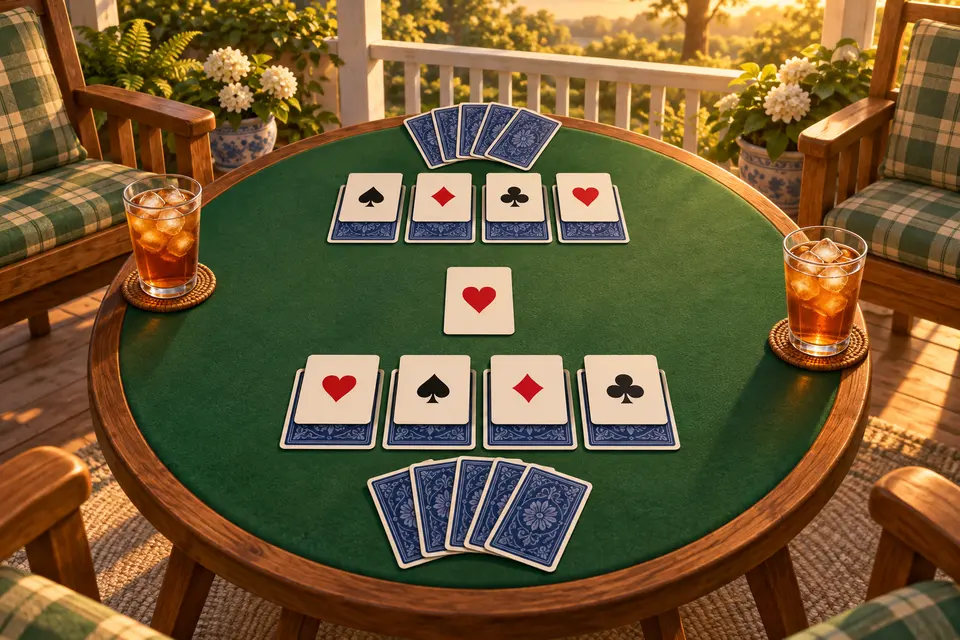
Euchre is built for four: two partnerships, five cards each, and a lot of table talk about who called what. But if there are only two of you, you don’t have to put the cards away. Euchre has been played two-handed for a very long time, and there are a few good ways to do it.
There’s no single official version, so this guide covers the two you’re most likely to meet — the simple one that plays like regular Euchre, and a popular one where each player also plays from a row of face-up cards — plus a few other ideas. You’ll need a 24-card Euchre deck: the 9, 10, Jack, Queen, King and Ace of each suit.
A quick refresher
Everything below keeps the usual Euchre card order. Once trump is chosen:
- The right bower (the Jack of trump) is the highest card.
- The left bower (the other Jack of the same color) is second highest, and it counts as a trump, not as its printed suit.
- Then come the Ace, King, Queen, 10 and 9 of trump.
You must follow suit if you can, and the highest trump wins the trick — or the highest card of the suit led if no trump was played. If any of that is new, our Euchre rules guide explains it with examples.
Version 1: regular Euchre, two hands
The simplest way to play is to deal two hands instead of four and play Euchre as usual.
The deal
The dealer gives five cards to each player, in packets of two and three. The next card is turned face up as the up card, and the rest of the deck is set aside, unused. That leaves 13 cards out of play every hand, which is what makes this version so different from the four-player game: either bower could be sitting in the unused cards.
Choosing trump
Bidding works exactly like regular Euchre, with only two voices:
- Round one. The non-dealer may order up the up card, making its suit trump, or pass. If they pass, the dealer may pick it up or pass. Whenever the card is taken, the dealer adds it to their hand and discards one card face down.
- Round two. If both pass, the up card is turned down. The non-dealer may name any other suit, or pass, and then the dealer gets the same choice.
If both players pass twice, throw the hand in and let the other player deal. (If you like stick the dealer, the dealer must name a suit instead.)
Playing and scoring
The non-dealer leads the first trick, and five tricks are played. Score it like regular Euchre:
| Result | Points |
|---|---|
| Maker takes 3 or 4 tricks | 1 to the maker |
| Maker takes all 5 tricks (a march) | 2 to the maker |
| Maker takes fewer than 3 (euchred) | 2 to the other player |
Play to 10 points, or 5 for a quick game. An old rule book from 1863 describes this two-handed game played to 5, with a 32-card deck that adds the 7s and 8s — a nice option if the short deck feels too thin.
Going alone doesn’t mean much without a partner. Some players use it to mean “I promise to take all five tricks”: a bigger reward if you do, and a euchre if you don’t. Agree on the payout before you start.
What it’s like
Version 1 is quick and easy to teach, and it keeps the bidding that makes Euchre fun. The catch is luck. With more than half the deck unused, you’ll often call trump on a hand that looks strong and run into a bower you couldn’t have known about.
Version 2: a hand plus face-up rows
This is the version many families mean when they say two-handed Euchre. All 24 cards are dealt, and each player plays from their hand and from cards laid out on the table in front of them.
The deal
Deal each player:
- A row of four cards face down in front of them,
- four cards face up, one on top of each face-down card, and
- four cards into their hand.
That’s 12 cards each, and every card in the deck is in play. Each face-up card hides a face-down card beneath it.
Bidding
Because there are 12 tricks to play, the bidding is about how many tricks you’ll take, not just whether you’ll take three:
- The non-dealer bids a number of tricks and the trump suit they’d choose (some families also allow no trump).
- The dealer passes or bids higher. Bidding goes back and forth until one player passes.
- The high bidder names trump and must take at least the number of tricks they bid.
Some tables set a minimum bid of 7 — more than half the tricks. If you play no trump, there are no bowers that hand, and every Jack ranks in its own suit.
Playing
The non-dealer leads the first trick, and after that the winner of each trick leads. On your turn you may play any card in your hand or any face-up card in your row. When you play a face-up card, turn over the card that was under it; it’s now available too.
Treat your face-up cards as part of your hand when it comes to following suit: if you can follow from your hand or your row, you must.
Scoring
Families score this version in different ways. Two common ones:
| Method | How it works |
|---|---|
| Every trick counts | Each player scores 1 point per trick taken — but a maker who falls short of the bid loses the number they bid instead. |
| Only the maker scores | A maker who takes 7 tricks scores 1 point, plus 1 for each trick beyond 7. A maker who falls short scores nothing. First to 10 wins. |
Pick one before you deal, and set a target that suits it.
Strategy for Version 2
- Read the table. You can see your opponent’s four face-up cards, and they can see yours. That’s a third of their cards known before the first bid.
- Remember what’s hidden — including from you. Your own face-down cards are a mystery to you as well. Of the 24 cards, you can see 12; the other 12 are your opponent’s hand and the face-down cards under both rows.
- Free your hidden cards early. Playing a face-up card uncovers a new one. If you hold strong trumps in hand, leading from your row first can bring more cards into play for you.
- Bid for the cards you know. Count your sure tricks from the cards you can see, then add a little for the cards still hidden. Overbidding is the quickest way to lose a hand.
Other two-handed ideas
A few more versions turn up at kitchen tables:
- Pick a hand. Deal two five-card hands to each player. You pick up one, and the non-dealer may swap theirs for the second hand.
- Dummy hands. Each player gets a normal five-card hand plus a three-card dummy, picked up after trump is named. Here, going alone means choosing not to pick up your dummy.
None of these is more correct than another. Try one or two and keep whichever your table enjoys.
Tips for any two-handed game
- Count trumps. Once the left bower joins it, the trump suit has seven cards. Knowing how many you’ve seen tells you how many your opponent could have.
- Lead trump when you made it. Pulling your opponent’s trumps protects your Aces, just as in the four-player game.
- Make voids. As dealer, discard a lone low card so you can trump that suit later.
- Bid with the score in mind. When your opponent is one hand from winning, call trump more freely — letting them choose it is often worse.
Many of the ideas in our Euchre strategy tips carry straight over to two players.
Play four-handed Euchre online
When you want the full game with a partner, you can play Euchre free on BieGames. It’s the classic four-player game: June is your computer partner, Rose and Hank are your opponents, and you choose Easy, Normal or Hard. Stick the dealer, the Canadian loner and defend alone are all in Settings, and the Hint button suggests a bid or a card while you learn.
Play Euchre free
Every game on BieGames runs right in your browser — no download, no sign-up, friendly computer players.